 Resorts & AdventuresResorts & Adventures
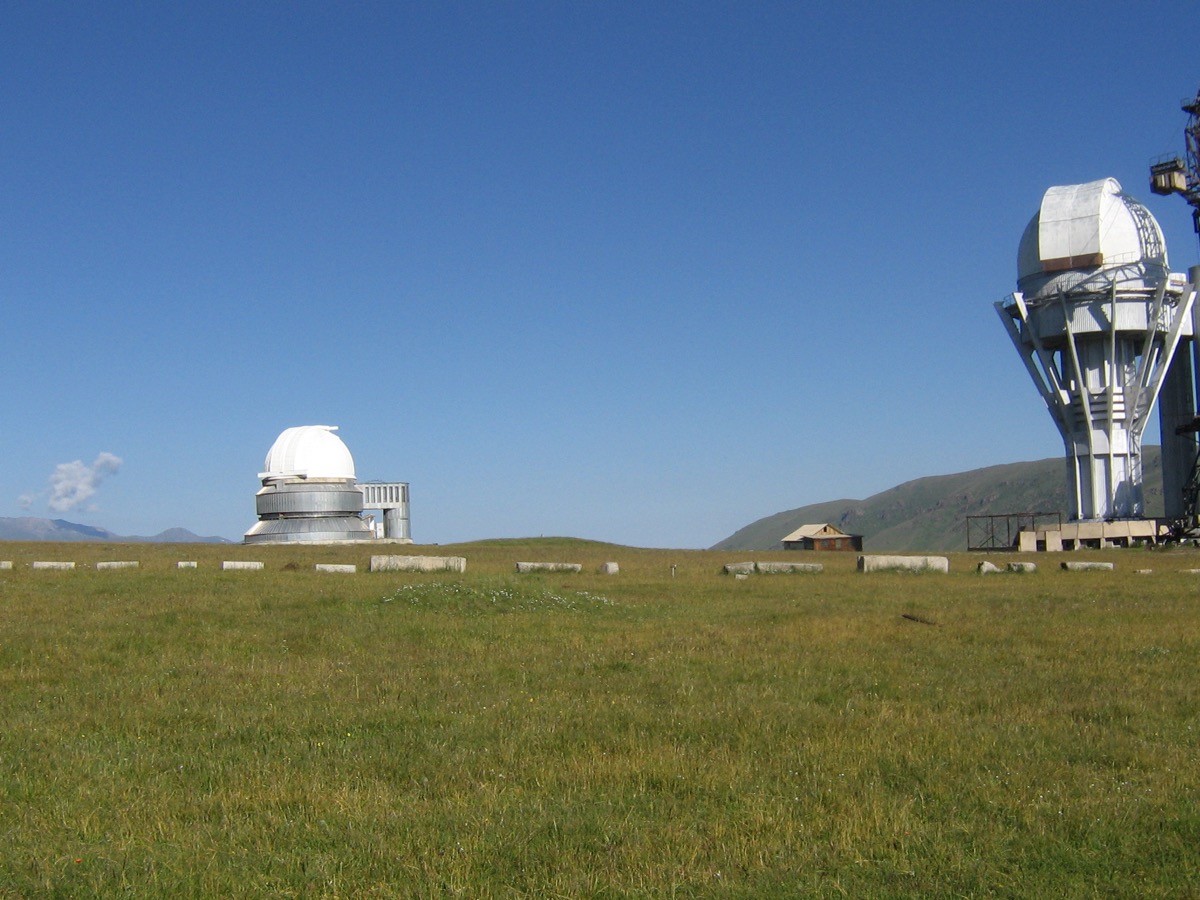
Photo: Utopiya87, CC BY-SA 3.0 · source
The Assy-Turgen Observatory stands on the high-altitude Assy plateau, 75–85 km east of Almaty. The plateau is vast, stretching roughly 40 km with elevations ranging from 2,100 to 2,800 meters. In summer, flocks of sheep and horses graze here alongside white yurts of shepherds. The steppe is dotted with burial mounds from the Scythian era and stone heaps from the Bronze Age—traces of far more ancient history in this region. The area is protected: golden eagles and vultures nest here, while foxes and marmots inhabit the plains. The drive to the observatory takes about three hours via the Kuldzha tract, through Turgen Gorge or past Bartogai Lake; the asphalt ends closer to the mountain pass, so a four-wheel-drive vehicle is recommended. There is no public transportation to this location. At the entrance to Ile-Alatau National Park, you must pay an environmental fee and obtain a permit—this is a restricted area, though open to tourists. It makes sense to visit from May through September: in winter the road is nearly impassable, and even on summer nights at this altitude temperatures drop to 3–7°C, so warm clothing is essential. Visitors typically spend a full day or stay overnight, often stopping by nearby Turgen Waterfall, and in July-August may catch the livestock herders' festival "Zhaylau-toy."
The observatory site was chosen scientifically. In the mid-1960s, astroclimate research was conducted here, and the Assy plateau was recognized as the best observation point in Kazakhstan. Construction began in 1975, and the first telescope—a one-meter Carl Zeiss—became operational in 1981. At the same time, work began on a dome for a 1.5-meter AZT-20 reflector, but in 1992, following the Soviet collapse, construction was frozen: the tower and building were completed, but the telescope itself was not. The project remained frozen for over twenty years. Work resumed in 2014; the main mirror was installed by late 2015, and the telescope saw first light in October 2016. The AZT-20 entered operational service on July 27, 2017—from that day, Kazakhstan had the largest telescope in Central Asia. More than forty years passed from the start of construction to the telescope's first light—a rare case where an object's history is measured not in years but in decades.
The observatory belongs to the Fesenkov Astrophysical Institute, which also manages the Tian-Shan station south of the city. However, these are two independent facilities with different histories and different missions: Assy-Turgen is younger and located where the sky is cleaner. The site is justly considered Kazakhstan's best astroclimate location—it has minimal air turbulence, virtually no light pollution, and very high sky transparency. In practice, this means stars here do not "twinkle" in the telescope's lens as they do in lower, more populated areas, and the faint light from distant objects is not lost in urban glow. For astronomers, these three parameters matter more than any architectural refinement. Even the observatory's first telescope, the one-meter Carl Zeiss that operated from 1981, is currently undergoing modernization—this is not a museum of old equipment but a living facility where instruments evolve with scientific needs.
For a long time, the main focus here was the study of variable stars—young T Tauri-type stars, Herbig stars, and symbiotic systems. These stars show significant changes in brightness, hence the name "variable." Today, the primary task of the AZT-20 telescope is to catch the afterglow of gamma-ray bursts, the most powerful explosions in the universe since the Big Bang, before it fades. The burst itself lasts seconds, but its optical afterglow persists for hours and days. Only an observatory with a large mirror and truly dark skies can detect it—ready to begin observations at any moment once a new burst alert arrives. Assy meets both requirements, and this is precisely why forty years of waiting for one telescope was worth the effort.