 Resorts & AdventuresResorts & Adventures
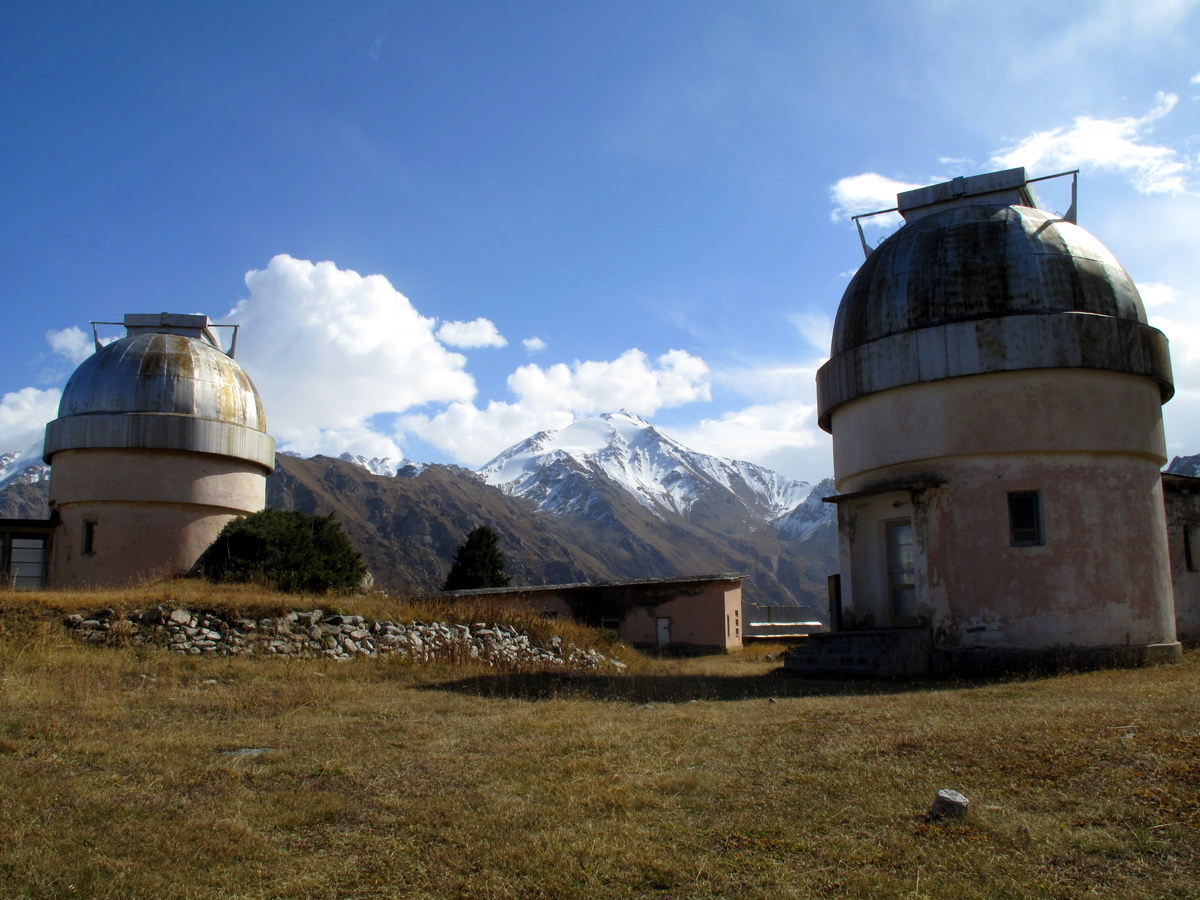
Photo: Peretz Partensky, CC BY-SA 2.0 · source
The Tyan-Shan Observatory stands high in the mountains along the road to Big Almaty Lake, roughly 30-60 minutes' drive from the city — requiring an additional two kilometers beyond the lake's viewpoint. This is not a museum or observation platform, but a functioning scientific station where astronomers, engineers, and physicists still work today. Some of them live on-site in the residential building. The territory hosts four distinct facilities: the observatory itself, a separate solar station, the Orbita radio facility, and a cosmic ray station. The road up follows the same hairpin turns as the route to Big Almaty Lake, and offers spectacular views of the entire Zailiyski Alatau range along the way. In winter, it's best to avoid traveling here — trails become icy and the surrounding slopes pose avalanche hazards. Entry is by appointment only: the observatory belongs to the Fesenkov Astrophysical Institute, and the checkpoint with barbed wire does not allow unannounced visitors from the highway. All visitors, regardless of nationality, must carry identification documents. Foreign visitors should provide passport information at least a week in advance. For the best starry sky experience, evening visits are recommended — the night sky here looks entirely different from the city..
The observatory was founded in summer 1957, during June-August, as part of the International Geophysical Year — an ambitious scientific project in which dozens of countries simultaneously studied Earth and space. Originally a high-altitude expedition of the Sternberg State Astronomical Institute at Moscow State University, it was established by astronomer Elena Makarova. The high-altitude location quickly proved its worth: by 1962, the temporary expedition became a permanent scientific station. Following the Soviet Union's collapse, the observatory remained in Kazakhstan, and in 1994 it was transferred to the Fesenkov Astrophysical Institute — which oversees it to this day. Over nearly seven decades, the station evolved from a temporary geophysical camp into a scientific center with four simultaneous observation directions.
The station's key instruments are two automated German-made one-meter Zeiss telescopes. Kazakhstan has only three such telescopes in total, and two of them are located here: one faces east, the other west. The western telescope is equipped with a spectrograph. This instrument splits the light from distant stars into a spectrum — much like a prism breaks light into a rainbow. Scientists use the pattern of lines in this spectrum to determine a star's chemical composition and search for exoplanets beyond our Solar System. Following recent modernization, the field of view of one telescope has quadrupled, enabling it to detect objects up to 13 billion light-years away — nearly at the edge of the observable universe. One of the station's telescopes is specifically shown to visitors during tours: you can see firsthand what scientists observe, rather than just hearing about it from a distance.
Since 1968, the observatory has continuously monitored the Sun, and the Orbita radio facility tracks solar radiation and warns of magnetic storms. The logic is straightforward: charged particles reach Earth two or three days after a solar flare, allowing time to warn satellites and power grids about the approaching storm. The facility also studies white dwarfs — extinct stars in their final life stage — helping predict what eventually awaits our own Sun. Additionally, they monitor Kazakhstan's KazSat satellites to calculate collision risks with space debris in time. The telescopes are operated remotely via the internet, so astronomers worldwide use observations from here: while it's night in Almaty, it's daytime elsewhere on the planet, and observations continue uninterrupted. International collaboration is not an exception but the norm here: once, by combining data from telescopes in Kazakhstan and Mexico, an astronomer from Moscow discovered a new comet in just a few hours.