 Resorts & AdventuresResorts & Adventures
Photo: Stomac, CC BY 3.0 · source
Tamgaly-Tas lies on the left bank of the Ili River, approximately 120 km north of Almaty. The journey is quite long: along the northern highway through Konaev, across a bridge over the Ili, and at the Taldykorgan—Bakanasy junction, turn left towards Bakanasy. The asphalt road ends roughly 10 km before the site, and the final stretch is an unpaved road across the steppe. The one-way journey takes about two hours. On site are cliffs above the river, covered with images from two completely different eras: some were carved by Buddhists in the 17th–18th centuries, while others were created by Turkic peoples almost a thousand years earlier. It is best to travel in the early part of the day: the last unpaved section has no street lighting, and it is better to drive through and leave it behind on the return journey while there is still daylight.
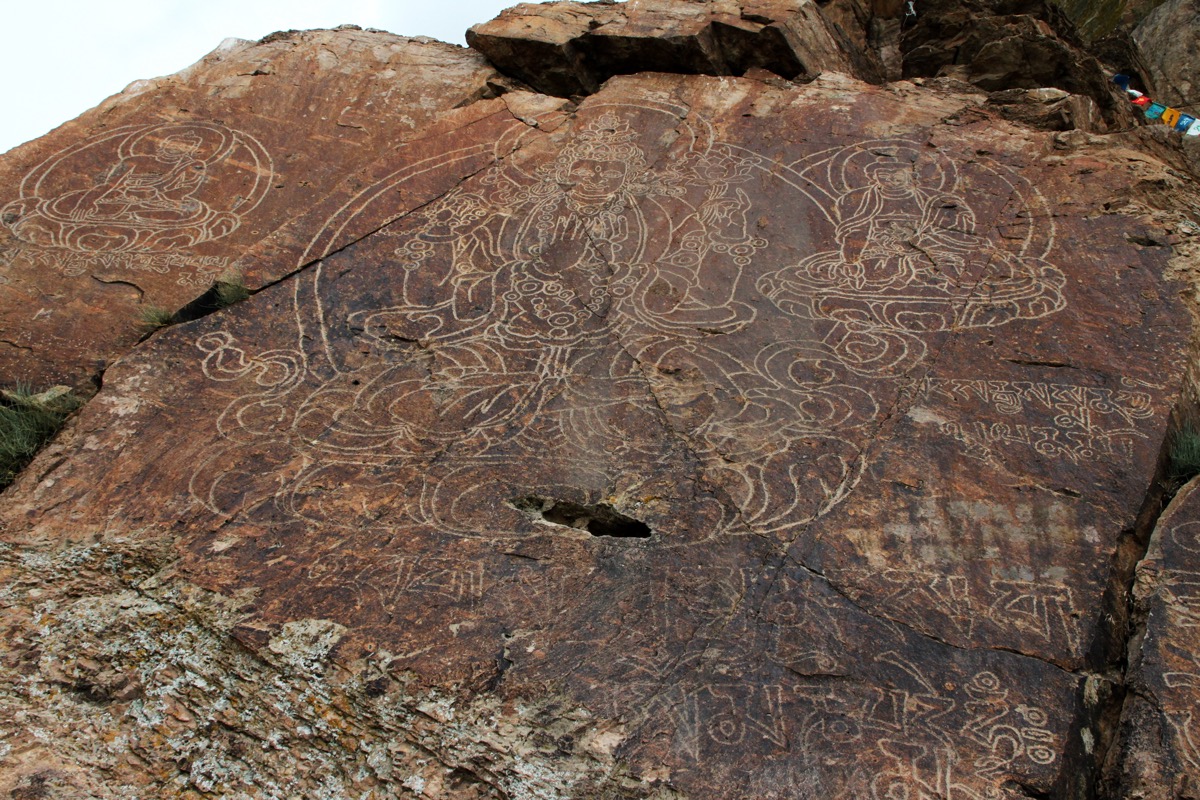
Chingis Valikhanov was the first to describe this place: in 1856, the Kazakh scholar and traveler sketched the cliffs with their images. In 1899, Mongolist Alexei Pozdneev published a detailed description in the journals of the Russian Geographical Society, and since then Tamgaly-Tas has been known to science. The Buddhist images themselves appeared later than the Turkic inscriptions on nearby stones. Tibetan and Oirat masters carved them in the second half of the 17th century, during the era of the Dzungar Khanate—a nomadic Buddhist state that existed in this region from 1635 to 1758. The mantras are carved in "clear script," which the Oirat monk Zaya-Pandita developed in 1648 specifically for translating Buddhist texts into the Mongolian language. The most recent inscription on the cliffs is a prayer text left by Volga Kalmyks who fled in 1771 to the Ili valley, the same place where these cliffs stand. It turns out the cliffs were "added to" for more than a hundred years: from the first masters of the Dzungar Khanate to the refugees of the 18th century, and each new generation left their own mark over the previous one.
There are approximately a thousand images on the cliffs, but five main figures, the largest ones, are the focus of attention. Among them are Buddha Shakyamuni, Buddha Amitabha ("Buddha of Infinite Light") and bodhisattva Avalokiteshvara ("Infinite Compassion"). Around them is carved in rows the mantra "om mani padme hum"—one of the most famous in Buddhism. On a separate stone nearby is a completely different story: ancient Turkic runic inscriptions dating to the 8th century, presumably left by the Kipchaks. On the same cliffs, different peoples left messages eight hundred to nine hundred years apart: first the Turkic nomads, then, much later, the Buddhists of the Dzungar Khanate. Two completely different worlds met on the same stone, unaware of each other.
It is important not to confuse Tamgaly-Tas with the more famous Tamgaly petroglyphic complex protected by UNESCO. That one is located 170 km from the city, and the drawings there are completely different—much more ancient and not connected to Buddhism. Tamgaly-Tas is a separate monument, protected by the state as a cultural heritage site. It continues to function as an open shrine: tourists and pilgrims leave ribbons and coins at the base of the cliffs, and the place itself is used as a Buddhist temple under the open sky.