 Out of TownOut of Town
Photo: Александр Коровайков, CC BY-SA 4.0 · source
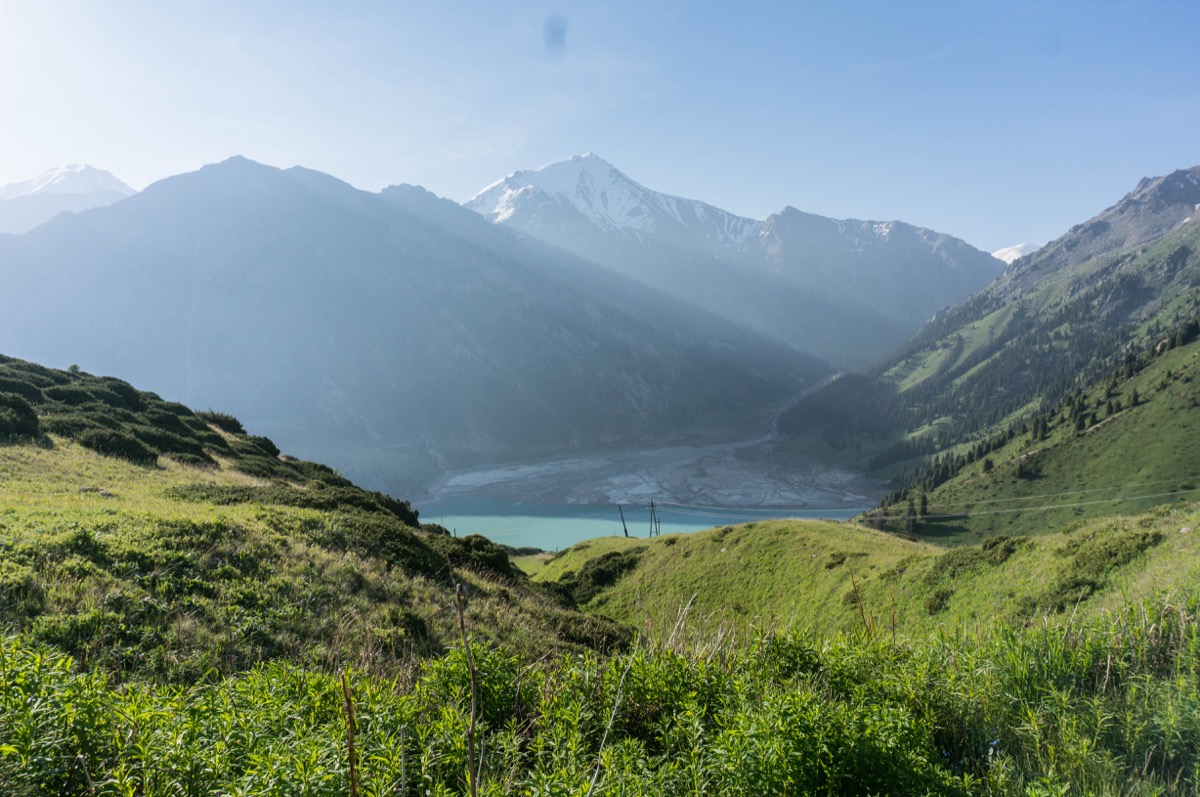
BAL is one of the most photogenic spots in the Almaty area. The water here changes color from turquoise to deep ultramarine, depending on the season and lighting conditions. All around are glaciers and snow-capped peaks of the Zailiyskiy Alatau. The road to the lake itself is already part of the experience: a winding mountain road climbs higher and higher, while the city below gradually disappears into the haze. This is a border zone with restricted access. You must bring your passport or ID card with you, and there is a checkpoint at the entrance. Swimming and fishing are prohibited here. The lake is a drinking water reservoir that supplies nearly a third of Almaty's water needs. It remains cool even in summer due to the high altitude, with a weather station on the lake situated at 2506 meters. Important note: as of mid-June 2026, access to the lake itself is closed for an indefinite period due to road repairs. The viewpoint and visitor center remain accessible, but it's worth checking the current status before your visit.
Like most lakes in the Tian Shan mountains, BAL was created by an earthquake. More than two thousand years ago, a powerful underground tremor caused a mountainside to collapse into a gorge. The landslide blocked the river channel, creating a natural dam behind which water gradually accumulated. This is how the lake formed at an altitude of 2510 meters. In the mid-20th century, a hydroelectric station was built here. Part of the water flowing out was diverted into a pipe that supplies water to the turbines of a cascade of power stations. The natural dam was reinforced with reinforced concrete over time. By the 1980s, it was raised by another 10 meters to allow the lake to hold more water and serve the city more reliably. Scientific facilities emerged near the lake: an astronomical observatory of the State Astronomical Institute named after Shternberg at 2700 meters altitude and a coronal station of the Academy of Sciences of Kazakhstan. Even higher, at the Zhusalykezen pass, stands the Cosmostation, a high-altitude scientific facility that has been recording cosmic radiation since Soviet times.
The color of the water in BAL is not simply a play of light, but a consequence of glacial melt. In summer, meltwater carries more sediment, making the lake appear greener and more turbid. By autumn, the flow weakens, the water becomes clearer and transforms into vibrant turquoise—this is the best time for those iconic photographs. The maximum depth reaches 40 meters. The difference between summer and winter water levels can be as much as 20 meters: the lake noticeably "breathes" throughout the year, and its shores look different each season. The observatory above the lake is not a museum piece but an active scientific facility: the thin air and clear mountain sky remain suitable for observations. Access inside is not always possible, but the white domes against the mountain backdrop are part of the route for those who continue further up the gorge.
BAL is part of the Ile-Alatau National Park and lies right at the border with Kyrgyzstan. You can reach it by car—your own, a rental, or as part of a guided tour, with most people choosing the latter option. There is also a hiking option: from the checkpoint to the lake and back takes about 6 hours of walking; the route is scenic but steep in places. In summer, many continue further into the mountains from here, with routes toward the observatory and the pass being popular with local hiking clubs. In winter, the lake partially freezes and the road becomes more challenging. Plan for more time and dress warmer than you think necessary down in the city.