 Out of TownOut of Town
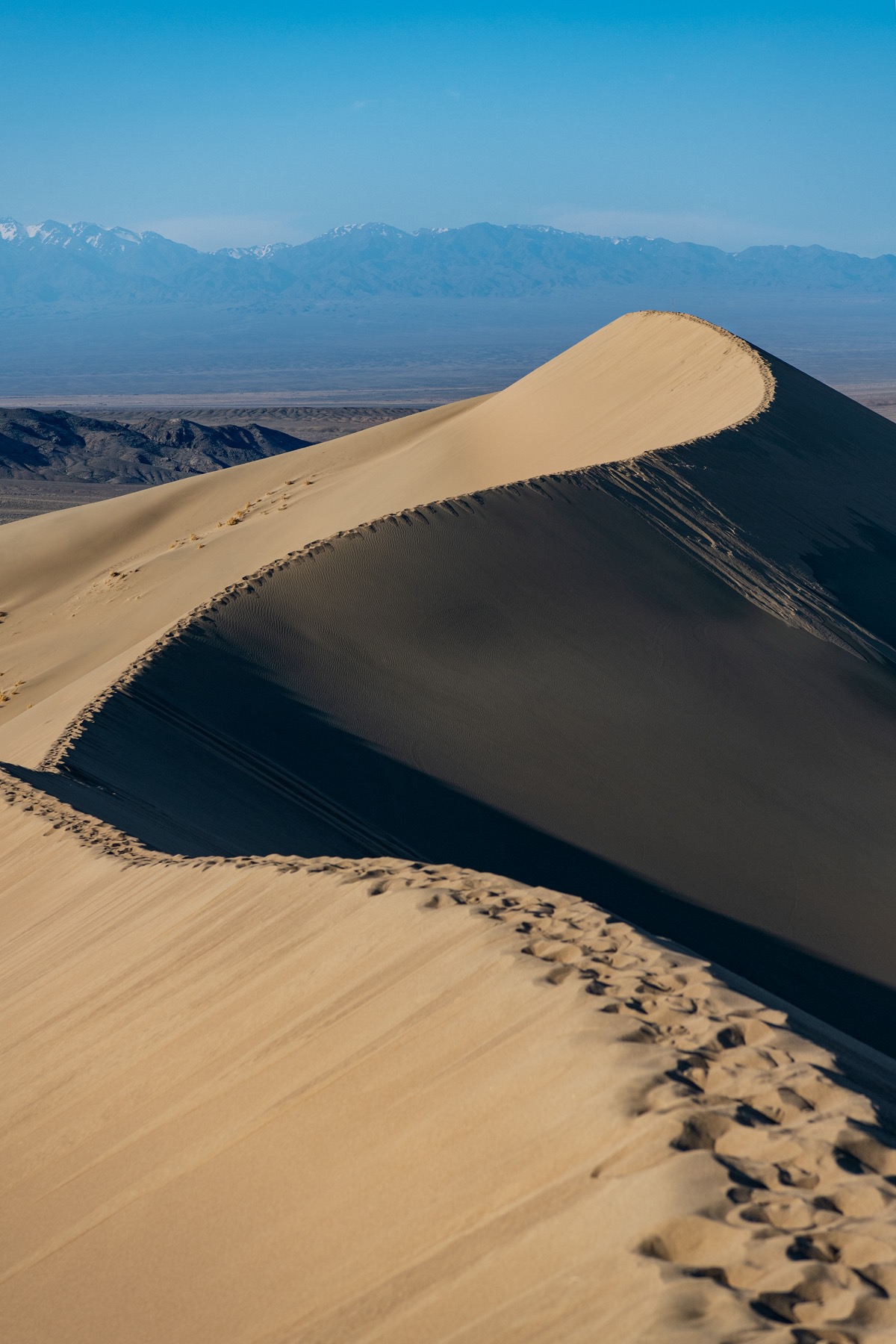
Photo: Maria Simonova, CC BY-SA 4.0 · source
The Singing Dune is a natural attraction in the truest sense: if you run and slide down the dune's ridge, the dry sand begins to hum — a low, drawn-out sound, as if an organ is playing in the distance or an airplane turbine is roaring. The sensation is so unusual that it's worth the trip to Altyn-Emel just for this. The dune is located within the national park of the same name, roughly 180 km northeast of Almaty. You cannot enter the territory independently: a permit is issued in the village of Basshi at the park's central office, and then the route passes through the Shygan and Mynbulak checkpoints — a total of about 46 km within the park. Many people travel on organized tours: an early departure from Almaty, several hours of transfer by off-road vehicle, and the climb up the dune and descent back takes about two hours at the site. The sand beneath your feet is surprisingly soft and pleasant, no special training is needed — regular sports shoes and willingness to climb the loose slope are enough.
The history of this place spans hundreds of thousands of years before the first tourists arrived here. About 200,000 years ago, tectonic movements shifted part of an ancient volcano and formed the Maliy Kalkan mountain range. These mountains became a natural barrier to the wind that carried sand up the Ili River valley. For millennia, the wind lost speed here and dropped sand particles in the same location, and about 10–12 thousand years ago the entire current mass of sand accumulated. The sound produced by the dune was seriously studied only in 1962. Leningrad physicist V. Arabadzhi established that the sound arises from the friction of sand grains against each other during movement — from wind, footsteps, or sliding down the slope. Later, scientists suggested other mechanisms, including the effect of compressed air between layers of sand, but the friction theory remains the main explanation. Before this scientific explanation, the local residents had their own: some told stories that a disturbed Shaytan sleeps beneath the dune, while others claimed that Genghis Khan and his companions were buried somewhere here, and their restless spirits were producing the sound.
Actually, there are two dunes: the main one, the Southern dune — the very one that sings, more than 3 km long and 150 meters high — and a smaller Northern dune beside it. Together they cover about 240 hectares. Not just any sand produces sound, but only dry and fine sand: if it rains, the dune falls silent for a day or two until the upper layer dries again. From a distance, the dune looks like a golden mountain in the middle of the steppe. It is one of the few dunes in the world that remains in the same place for centuries rather than shifting in the wind — the surrounding mountains simply prevent the sand from spreading. On a clear day from the ridge, you can see the Kalkan mountains themselves, the Ili valley, and distant mountain ranges.
The sound can be heard for several kilometers, and it is one of few natural phenomena of this kind in the world: the dune has repeatedly been nominated as one of the new wonders of nature. Brazilian author Paulo Coelho wrote about it in one of his novels, and Kazakh singer Dimash Kudaibergen filmed a music video here — for many, the dune has long been not just a natural but also a cultural landmark. It's best to visit in dry weather and not during the hottest time of day: climbing the loose sand is difficult enough, and under the blazing sun it's twice as hard. Along the road through the park, you often encounter kulan — wild asses that are protected and resettled here — and sometimes Przewalski's horses. It's worth making time for the other iconic attractions of Altyn-Emel — the clay canyons of the Aktau mountains and the volcanic rocks of Katutau — but that's a separate route and a separate trip.