 Out of TownOut of Town
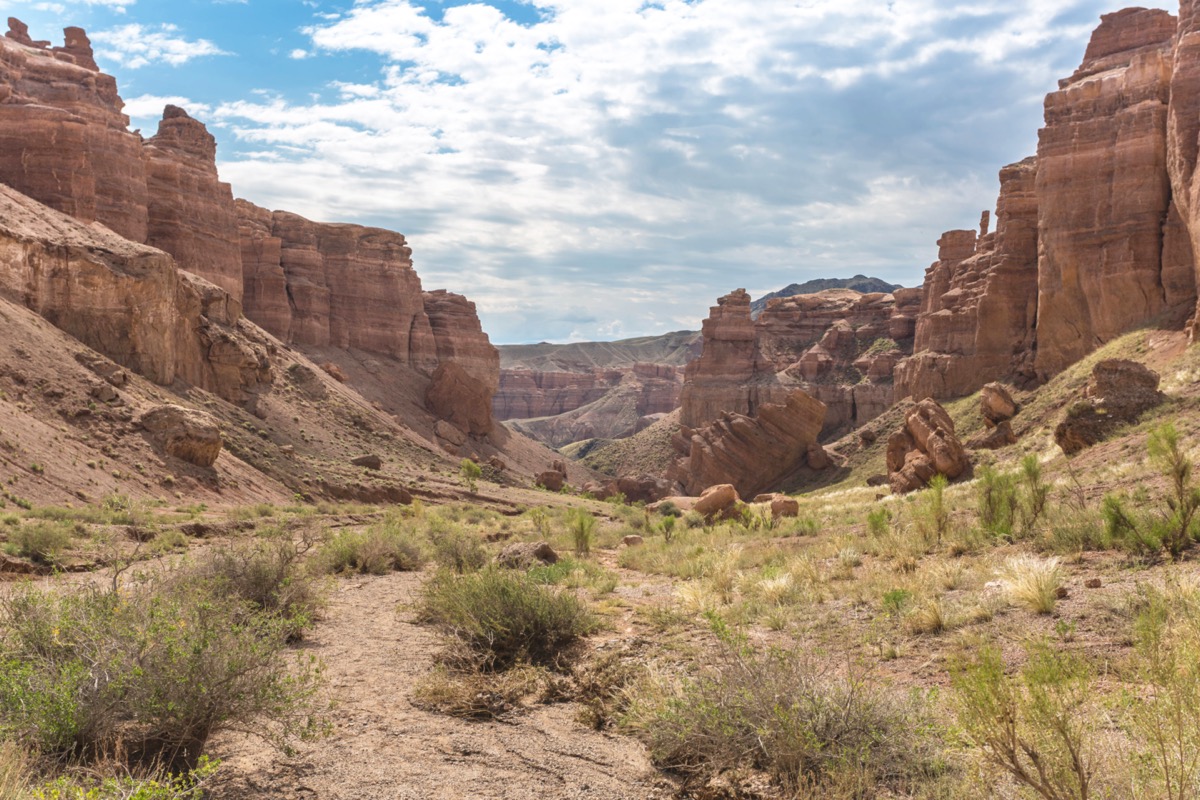
Photo: Marat Rysbekov, CC BY-SA 4.0 · source
Charyn Canyon is often called Kazakhstan's Grand Canyon—and for good reason: red cliffs stretch for tens of kilometers, and the most spectacular section, the "Valley of Castles," looks like a movie set. The drive from Almaty is about 200 km, taking roughly three to three and a half hours: the asphalt road is in good condition almost all the way, with the last few kilometers on a dirt road. Accounting for time spent at the site, a round trip usually takes 12–15 hours. At the entrance to the national park is a checkpoint where entrance fees are collected—approximately 815 tenge per person—and nearby is a visitor center with a small exhibition about the canyon. The best time to visit is April–June and September–November: in spring the canyon is lush green with a full-flowing river, and in autumn it turns golden-crimson. Summer temperatures reach +35...+38 °C in the shade, but winter is surprisingly comfortable—there is almost no snow and there are plenty of sunny, warm days.
The canyon is approximately 12 million years old—the time it took water and wind to carve the current formations into sedimentary rock. The "Valley of Castles" is actually a dry ravine carved by meltwater that runs perpendicular to the Charyn riverbed. The claystone here takes on a reddish hue in the sun, and its fantastical shapes resemble castle towers and fortress walls. These places did not receive protected status immediately: the ash grove at the bottom of the canyon became a nature monument in 1964, and the Charyn State National Nature Park itself was established later, on February 23, 2004, covering an area of 93,150 hectares. In 2009, the territory was expanded to nearly 127,000 hectares.
The canyon's total length along the river is 154 km, and the Charyn River itself, stretching 255 km, carves through rock to depths of up to 300 meters in places. The canyon lies across three districts of Almaty Region. Against this backdrop, the "Valley of Castles" is a compact section—about 2 km long and 20 to 80 meters wide—but it is the most striking: narrow corridors between towers of sandstone tens of meters high, with each turn revealing a new perspective. You can descend into the valley on foot without special equipment, though the climb back up feels considerably harder and this should be kept in mind when planning your time.
The canyon is interesting for more than just its rock formations. More than 1,500 plant species have been recorded here, 17 of which are listed in the Red Book of Kazakhstan. The fauna includes 62 mammal species—from foxes to mountain goats—over a hundred nesting bird species, 25 reptile species, and several amphibian species. The star among plants is the relict grove of Sogdian ash at the bottom of the canyon: this species survived the ice age, and a similar grove is found only in North America. The grove received protection as a nature monument in 1964—forty years before the national park itself was established.
The "Valley of Castles" is the most famous section, but not the only one in the park. The canyon system also includes Bestamak, whose name translates as "five dishes," the Yellow Canyon with an almost lunar landscape, and Temirlik—the "iron canyon" with grottoes and its own ash groves. These are visited less frequently, usually with a guide or as part of a multi-day route, but they are less crowded.
When descending and ascending through the "Valley of Castles," it is best to wear closed-toe shoes—the sandstone crumbles underfoot, and there is almost no shade on the route, so in hot weather bring at least 2 liters of water per person and sun protection. If desired, you can spend the night in the park: camping is permitted in designated areas, but you will need to bring firewood and warm clothing with you. Many tourists combine Charyn with Kolsay Lakes and Kaindy: all three sites lie in the eastern part of Almaty Region, and a single-day trip can easily be extended to two or three days if time permits.