 Out of TownOut of Town
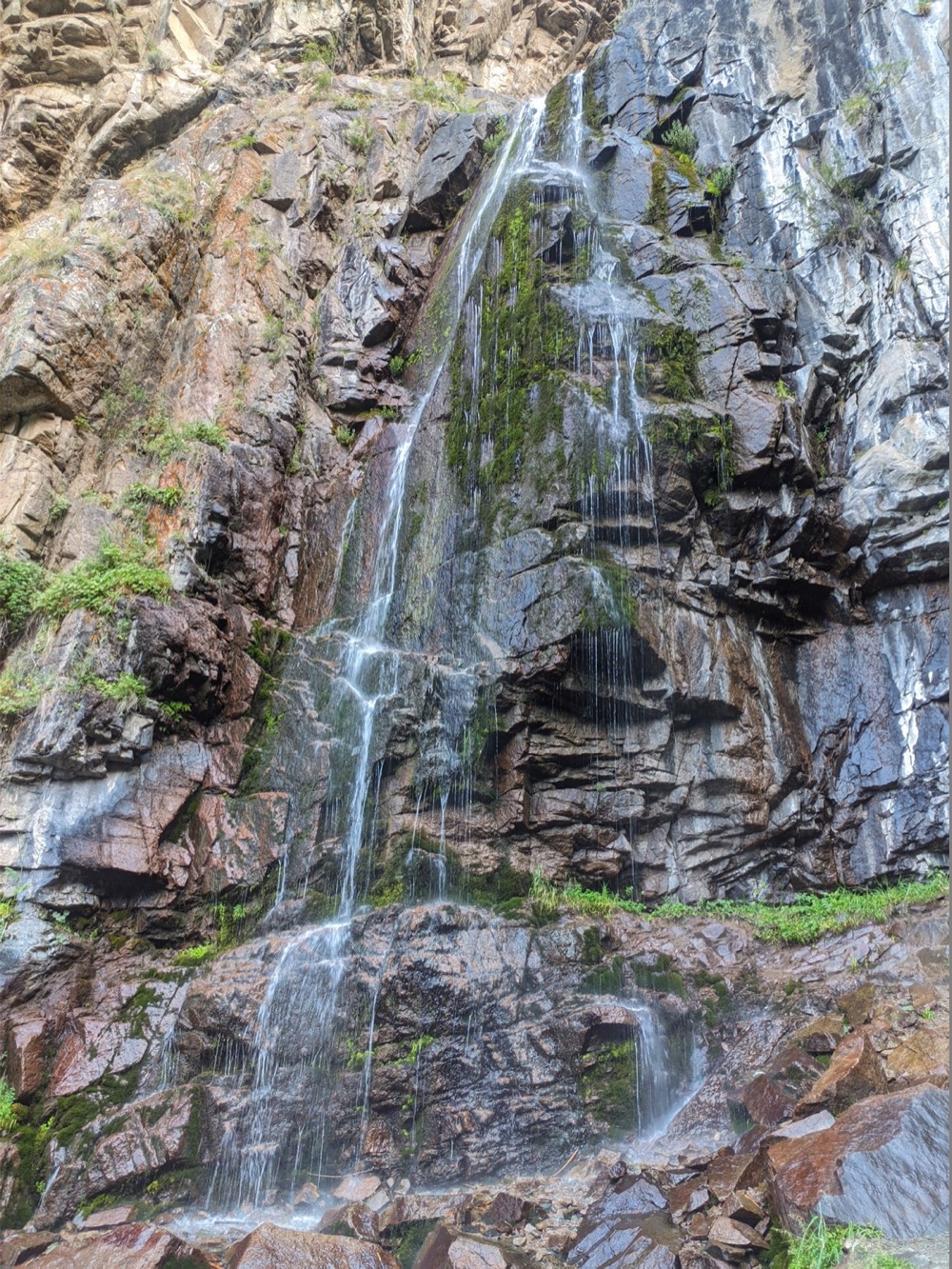
Photo: Жасминовый Дракон, CC BY-SA 4.0 · source
Butakovskoe Gorge is one of the most accessible mountain hikes near Almaty: just about 17 km from the city center, the asphalt road ends quickly, and then comes a trail along the Butakovka River leading to two waterfalls. It takes about 40 minutes by car from the city to reach the trailhead, with asphalt extending 9 km from the turn off Dostyk Avenue. You can also get there without a car: buses 29 and 29R run from the intersection of Dostyk and Satpayeva. At the entrance to the recreational area, there is a barrier gate where an ecological fee of 500 tenge per adult and 250 tenge per child is charged; pensioners and veterans enter free of charge. Pedestrians and cyclists are let through without payment, as are those entering from the Medeo side. From the second barrier gate to the Lower Waterfall, it is 2.6 km: first a gentle gravel road through a spruce forest, then the trail descends to a stream, crosses it via a small bridge, and climbs up a rocky riverbed. The hike to the Lower Waterfall and back can be completed in one day without special training—an ideal option for those who want mountains but without lengthy preparations.
The gorge lies in the Zailiyski Alatau—a young, still-growing mountain range. The mountains here began rising in the Pliocene and over 13–14 million years have grown to approximately 2,500 meters, and continue to rise at an average of 5 mm per year. The name "Butakovka" has several versions of its origin. One connects it to the Kazakh word "bûtaq" meaning branch or twig, hence "bûtaqty," meaning branched or ramified. Another version is far more specific: the gorge was named after a forester named Butakov who lived here and protected the forest until 1917. There is also a third, earlier version—that the gorge was named in the 1860s by the commander of a military detachment stationed here to guard the forest.
The Lower Waterfall stands in the Medeu district of the gorge—the most powerful and spectacular: water falls from 30 meters almost vertically, surrounded by moss-covered rocks. In summer, you can stand under its icy streams if you are not afraid of the cold, and the moss on the surrounding stones only makes the landscape more vivid. In winter, the waterfall transforms into a wall of icicles and ice sculptures—people come here even in freezing temperatures to see it. The Upper Waterfall is already in the Talgar district, about three kilometers further up the gorge, at an elevation of 2,470 meters. The stream here is narrower, and it is not always possible to see the entire waterfall: the gorge is shaded, and snow in the crevices may not melt even in summer. The best time to hike to the Upper Waterfall is late summer and early autumn, when there is the least snow.
The gorge is home to Tian Shan spruce, aspen, rowan, barberry, and wild apple trees—descendants of the wild apple orchards for which the mountains around Almaty are famous. Along the way, the trail passes a small ski slope with a training lift: in winter, people ski here who do not want to travel to Shymbulak or Ak-Bulak. For those who want to venture beyond the tourist trail, the gorge offers five passes into neighboring valleys—Butakovskiy (2,910 m), Lesnoy (2,330 m), Komissarovskiy (2,200 m), Yunnatov (1,450 m), and Bezymyanniy (1,880 m); these are routes for experienced hikers, not for a Sunday stroll.
For a hike to the Lower Waterfall, sneakers with good traction and a bottle of water are sufficient: the route is short, the elevation gain is modest, and the trail is well-worn and easy to follow without a guide. In spring, during March-April, be more careful—small avalanches are possible in the gorge during this time. In winter, it is worth wearing more sturdy footwear—the trail is icy in places—and the waterfall itself looks particularly striking in winter, transforming into a solid wall of ice.