 Out of TownOut of Town
Photo: Fukurukudzu, CC BY-SA 4.0 · source
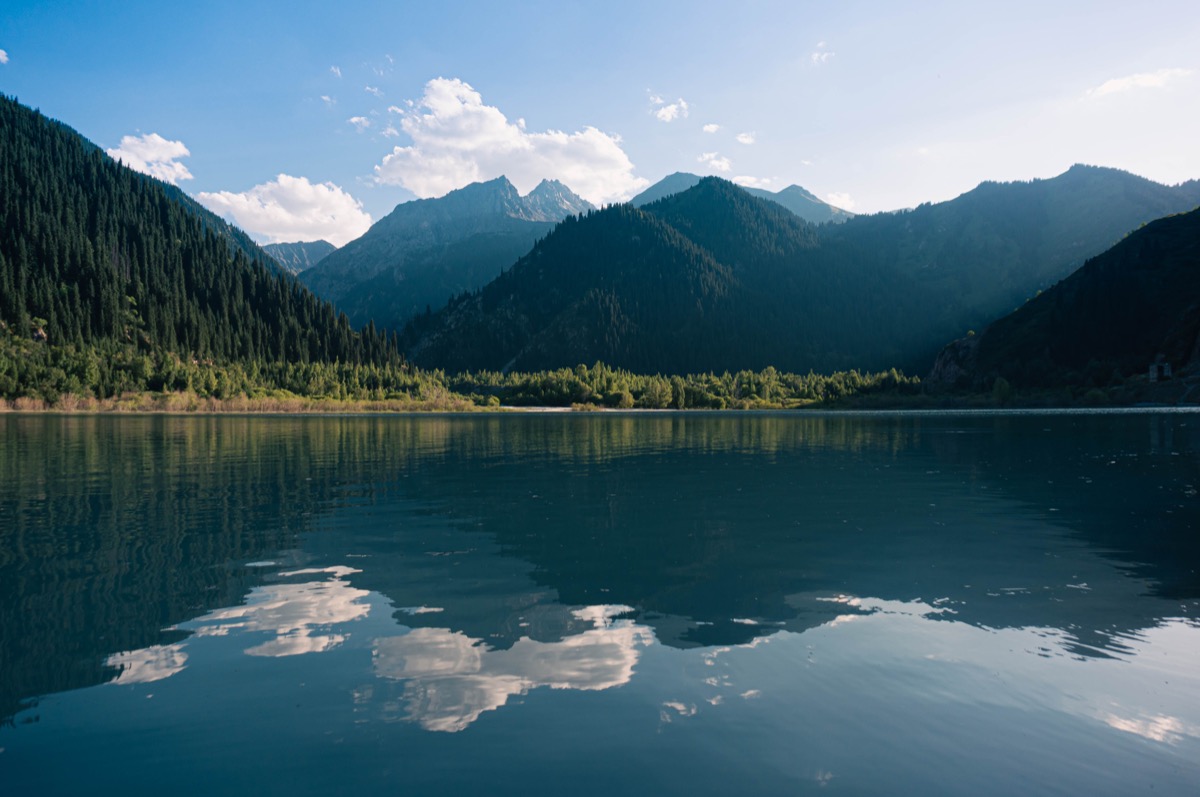
Issyk remains one of the most stunning landscapes near Almaty today—turquoise-green waters framed by mountains in the Issyk Gorge of the Zailiysky Alatau, roughly 70 km from the city and about an hour's drive away. However, the lake tourists see now is only a fraction of its former self: before 1963, there was a much larger lake measuring 1,850 meters in length, 500 meters in width, and up to 79 meters in depth. Swimming in Issyk is not recommended—the water remains icy even in summer—and fishing is strictly prohibited: the lake is used for breeding rainbow trout, and fishing here is banned.
The lake itself formed 8–10 thousand years ago when a rockfall in the mountains blocked the gorge with a natural dam approximately 300 meters high. Until the mid-20th century, it was a favorite recreation spot for residents of Almaty. After 1958, when a special decree was issued for resort development, it began receiving high-profile visitors: Ho Chi Minh and Nikita Khrushchev visited Issyk in different years. A two-story hotel with capacity for one hundred guests, a restaurant, a dance floor, and a photo pavilion were built on the shore, and a highway was constructed. Buses departed every half hour from the Central Collective Farm Market in Alma-Ata on weekends. On July 7, 1963, everything changed in a matter of minutes. Meltwater from a glacier on Mount Zharsai overflowed a small lake higher up the gorge, which burst through the natural barrier. A massive mudslide rushed downward and destroyed Issyk's dam. The debris flow swept away pioneer camps, rest houses, villages, fields, hydraulic structures, and even the cellars of the local winery. Official counts listed fewer than one hundred victims, but unofficial estimates ranged from two to three thousand. Army units evacuated approximately two thousand vacationers from the disaster zone, while some—such as mushroom pickers caught in the mountains—were not found for several days.
The lake turned into a field of boulders and dried mud. Reconstruction of the dam began in the mid-1980s, and work on the spillway structures was completed by the early 1990s. By the early 21st century, the water volume had returned to approximately three-quarters of its original level. A nearly mirror-image story emerged: nature created the lake with a rockfall in the mountains thousands of years ago—and nearly destroyed it with an identical rockfall in 1963. Today's Issyk, as tourists see it, is a lake in the process of recovery, not a museum replica of its former self.
Today, visitors come to Issyk as much for the views and hiking trails as for swimming. The shores here are granitic, covered with Tian Shan spruce, and the lake is rightfully called the pearl of the Zailiysky Alatau—the scenery is beautiful in any season, whether in summer heat or under snow. From the gorge, you can venture further to the waterfalls of the neighboring Turgen Gorge—the most famous being Bear Falls—and there are rock formations nearby suitable for beginner rock climbing. The lake itself can be walked around in less than an hour, and the route is easy, making it suitable for a family visit.
Next to the lake operates a trout farm where you can fish in small ponds and have lunch with your catch—for a fee, but the results are worth it. Many visitors also stop at the local museum dedicated to the famous "Golden Man"—a Saka warrior in golden armor discovered in an ancient burial mound near Issyk; this is one of Kazakhstan's most recognizable symbols. Given the icy waters of the lake, a visit here is worthwhile for the panorama and fresh mountain air rather than for beach recreation.