 In the CityIn the City
Photo: Stomac, CC BY 3.0 · source
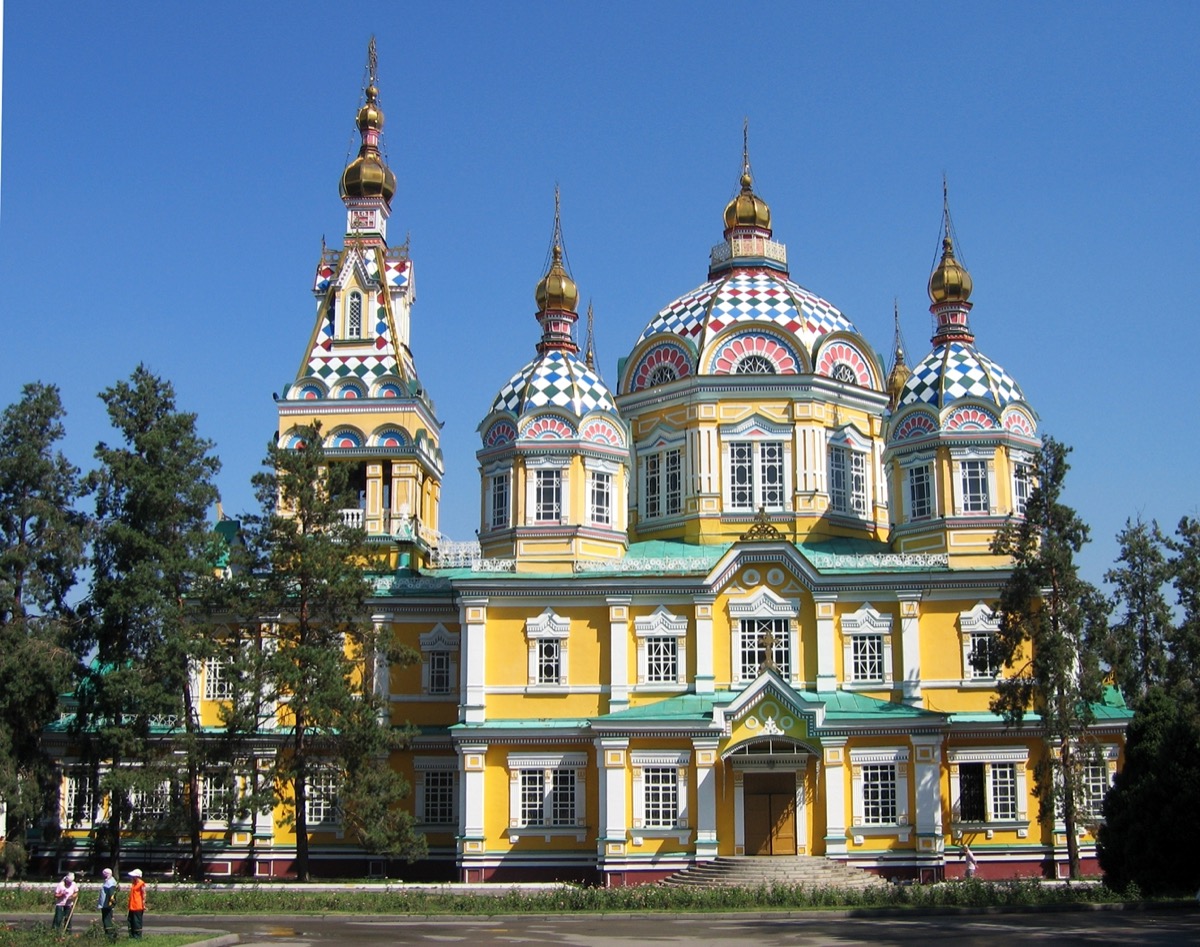
The bright yellow cathedral is visible from afar as you approach Panfilov Park — its wooden cupolas set against the backdrop of the Zailiysk Mountains look as if they've stepped out of a postcard. Inside, you'll find cool air, the scent of wood, and a genuinely active church that operates daily: you can simply walk in to admire it or attend a service. This is a functioning place of worship, not a museum, so entry is free any day of the week, but visitors should dress modestly and keep quiet, especially during services. The cathedral is easy to locate — it stands at the center of Panfilov Park, just a few minutes' walk from Zhibek Zholy metro station and the pedestrian Arbat.
The cathedral was constructed between 1904 and 1907 in the Pushkin Park of the city then known as Verny, serving as the cathedral of the Turkestan Diocese. The project's architect was Konstantin Borisoglebsky, while engineer Andrey Zenkov oversaw construction — hence the cathedral's alternative name, Zenkov Cathedral. The interior decoration was created by artistic workshops from Moscow and Kiev, with the iconostasis painted by artist Nikolai Khludov. The building's strength was tested just a few years later during the devastating 1911 earthquake that destroyed nearly all stone structures in the city; the cathedral suffered only a bent cross and cracked windows. In 1929, Soviet authorities closed the temple, expelling clergy and parishioners, toppling the crosses, and destroying the interior. The building was subsequently repurposed as a radio station and later as a local history museum. Only in 1995 was the cathedral returned to the Russian Orthodox Church, after which restoration work and religious services resumed.
The cathedral is often described as being built "without a single nail" — a romantic simplification. In reality, the structure contains over 170 puds of metal, roughly three tons of nails and bolts: the bell tower shaft and dome drums are laced through with metal reinforcements. The overall height is approximately 54 meters, with 41.4 meters extending to the sphere beneath the cross on the bell tower. The abundance of these metal connections likely contributed to the building's ability to withstand the 1911 earthquake. Inside, take time to admire the paintings — a wooden temple interior of such scale and preservation is rarely encountered even on a global scale. Strolling around the cathedral at a leisurely pace is worthwhile: it presents beautifully from various points throughout the park, and on summer mornings when the light is soft, the yellow walls and blue cupolas are particularly photogenic. Nearby you'll find the Museum of Musical Instruments and the Memorial of Glory, making it easy to extend your visit with a walk through the entire park.