 In the CityIn the City
Photo: irene2005, CC BY 2.0 · source
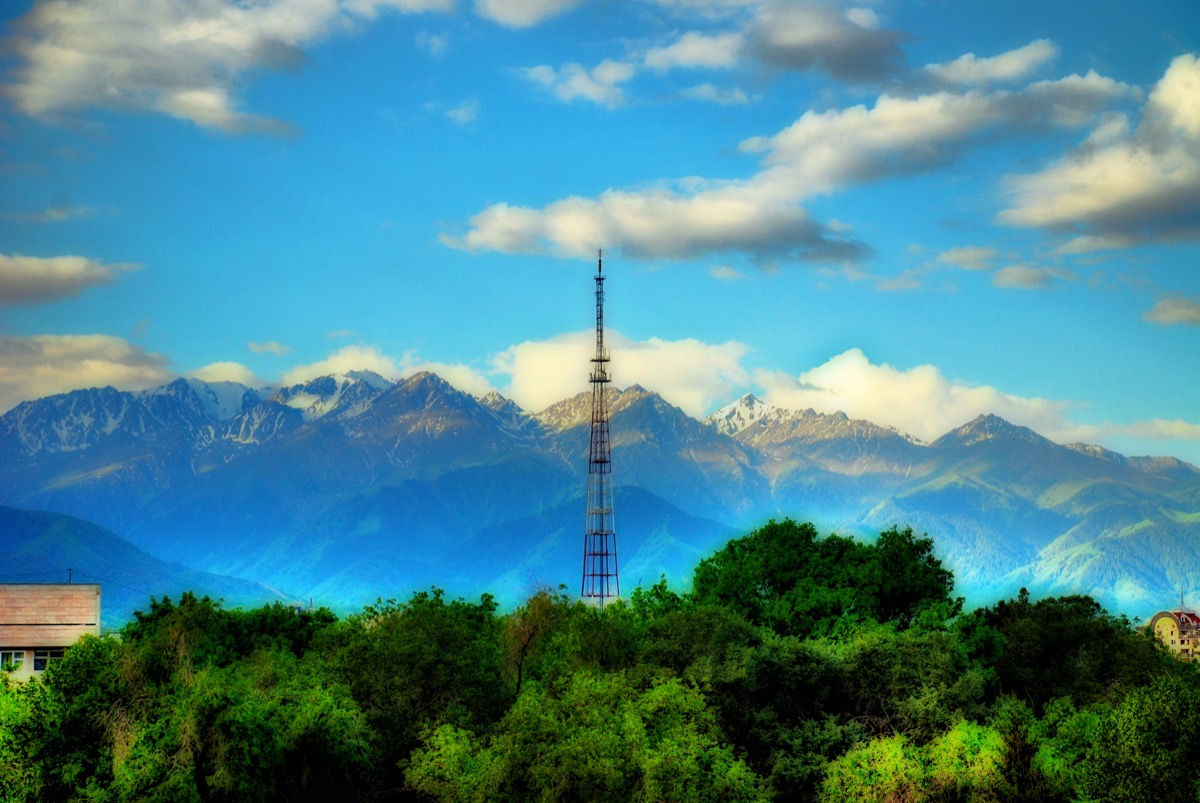
From Kok-Tobe, all of Almaty spreads out before you at once: below lies a dense grid of avenues, and stretching across the entire horizon beyond them rises the snowy wall of the Zailiyski Alatau. The mountain itself is the smallest peak of this range, at around 1,100 meters above sea level, yet it has become the city's main panoramic point. A cable car from the station at 104 Dostyk Avenue, next to the Arman cinema, carries visitors to the summit—public transport also stops here. The ascent takes 6-7 minutes and covers almost 1.7 km above the city, with the view constantly changing the entire way up. Tickets are available for single trips and round trips, with a separate children's fare; exact prices are best confirmed on site or on the park's official website as rates change periodically. During peak hours, expect queues at the ticket office. For those unwilling to wait, there's a separate express lane available for an additional fee. You can also drive up the winding road, but the cable car itself is part of the experience, not just a means of transportation.
The cable car first opened in 1967—from that point forward, Kok-Tobe essentially became a city park rather than simply a mountain on the outskirts. The current cabins and stations are newer: the entire system was completely rebuilt in 2014-2016. In the early 2000s, the summit underwent large-scale reconstruction: attractions were updated, a zoo was built, and restaurants and observation decks were added. The park's appearance that visitors see today took shape at that time. The TV tower at the summit—372 meters tall, constructed between 1975-1983—is one of the city's symbols alongside the mountains themselves. The name "Kok-Tobe" translates from Kazakh as "green hill": the slopes are indeed covered with forest, so even in heat it's noticeably cooler here than down below.
The main surprise for many visitors is The Beatles monument. The bronze sculpture by Eduard Kazaryan was installed here in 2007, coinciding with the launch of the national "Musical Peculiarity" award. John Lennon sits on a bench with a guitar, while Paul McCartney, George Harrison, and Ringo Starr stand behind him. According to several sources, this is the only monument in the world where all four members of the band are depicted together—and the first Beatles monument in the entire post-Soviet space. The band itself, according to legend, never actually visited Almaty: the monument became a tribute of respect rather than a reminder of a real visit. The location has become so popular for photographs that a small queue often forms at the bench next to Lennon.
The zoo at the summit is more than a cursory attraction: it houses giant pythons, a large tortoise, a rare caracal hybrid, civets, and several species of pheasants, guinea fowl, and peacocks. Two separate interactive zoos also operate. At "Best exotic animal," you can pet monkeys, parrots, and pythons. At "Noah's Ark," there's a similar format for visitors who came with children and want not just to look, but to touch. Beyond the zoo, there's a Ferris wheel and observation decks, a children's playground, a rock climbing wall, and fast roller coasters right at the summit. There's also an art gallery and a tea house. The "Yurta" restaurant is styled after a traditional Kazakh dwelling, complete with genuine carved wood and textiles rather than props—it's worth setting aside separate time rather than rushing between attractions. The "Wish Fulfillment" fountain in the shape of an apple is an almost mandatory photo stop for first-time visitors.
From the observation decks on clear days, you can see not an abstract "mountain range" but dozens of specific peaks of the Zailiyski Alatau. By some counts, roughly 39 peaks can be distinguished on the panorama. The highest among them is Talgar Peak, at approximately 5,000 meters. Further away are Chkalova, Karlyltau, the Victory in the Patriotic War peak, and others whose names few people remember, but the scale of the range on the horizon impresses even without labels.
Kok-Tobe operates year-round, but the experience changes with the seasons. In summer, the summit is noticeably more comfortable than the scorching city below—that very effect of the green hill that the name suggests. In autumn, the slopes change color and the air is particularly clear: the mountains on the horizon are visible more distinctly than in summer's haze. In winter, the snow-covered range becomes even more striking against the backdrop of the city, though the cable car and open platforms require warm clothing—it's almost always cooler and windier at the summit than below. The off-seasons—March-April and October—are times when there are fewer tourists and a better chance of finding the summit nearly to yourself.
Sunset is the most popular time to visit during the day: the city below gradually lights up, and the mountains on the horizon turn pink in the final rays. This is why the cable car is most crowded in the evening. In the morning and on weekdays—there are fewer queues and softer light for photographs. With children, daytime visits are more convenient while all attractions and the zoo are operating—some close earlier than the observation decks. One-and-a-half to two hours is enough for a leisurely walk around the summit; if you're combining it with dinner at "Yurta," allow more time.