 In the CityIn the City
Photo: Radosław Botev, CC BY 3.0 PL · source
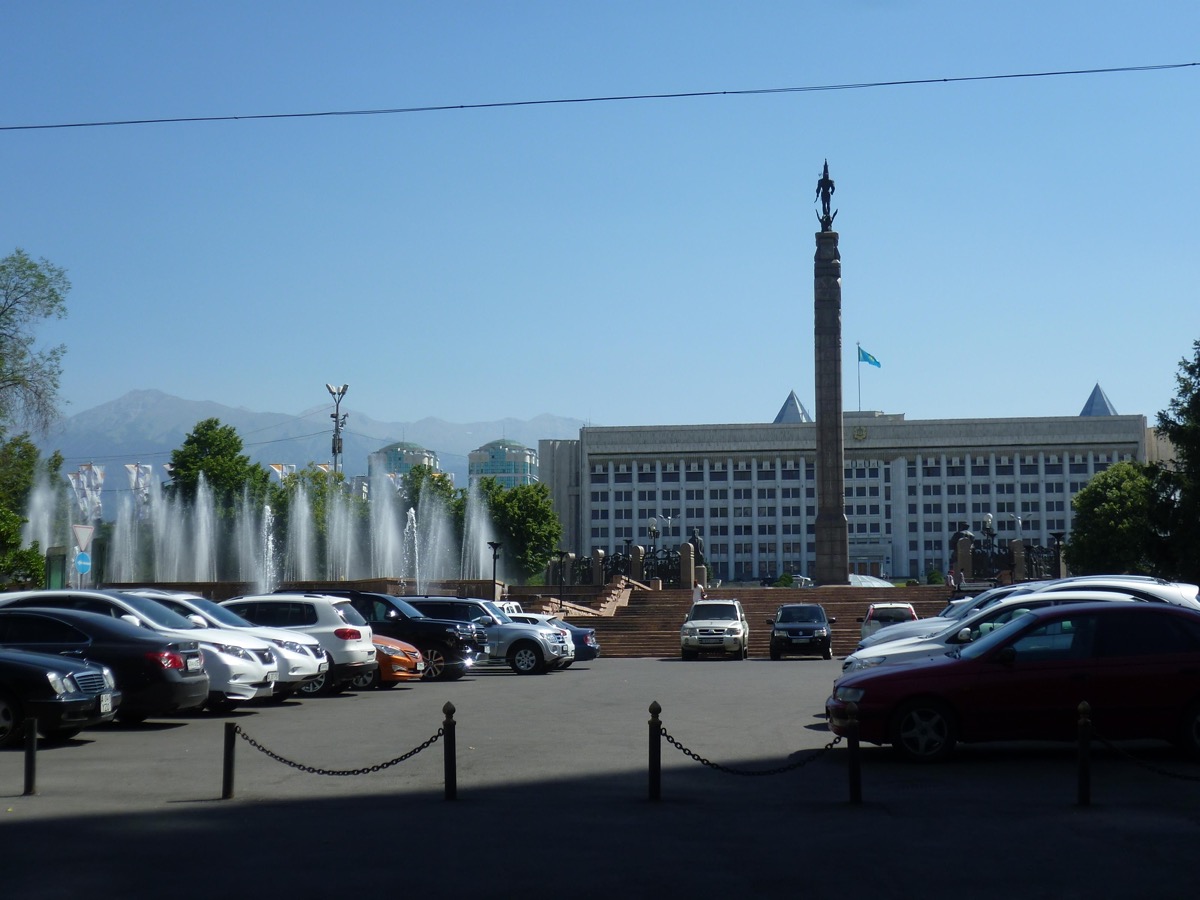
Respublika Square is where Almaty feels like a capital, even though it hasn't been one officially for over 25 years. At the center stands a 28-meter-high stele, and at its very top is the figure of the "Golden Man": he stands on a winged snow leopard (bars), holding a bow in one hand with an eagle perched on the other. The entire composition stretches 180 meters, and it's worth walking around it completely — along the edges are ten bas-reliefs depicting key scenes from Kazakh history. The most convenient way to reach it is by metro to the Alatau station, which exits almost directly onto the square; from the center, you can also take buses №5, 12, 29 and trolleybuses №11, 19, 25.
This square has a complex history that began long before the monument. During the Soviet era it was called Brezhnev Square, and it was here on December 17–18, 1986 that mass protests took place, which went down in history as Zheltoqsan. Young people took to the streets with the slogan "Every republic deserves its own leader!". The reason was the removal of Dinmukhamed Kunayev, the first secretary of the Communist Party of Kazakhstan, and the appointment of Gennady Kolbin — a man who had no previous connection to the republic. On May 23, 1990, the square was renamed Respublika Square as a symbol of independence and statehood, which the country would gain a year later. The Independence Monument was unveiled here on December 16, 1996, marking the fifth anniversary of Kazakhstan's sovereignty. The authors of the composition were Adilet Zhumabai and Sh.-A. Valikhanov, and the central stele's shape is reminiscent of Mangystau kalpytasy — traditional stone burial monuments from western Kazakhstan.
The "Golden Man" at the top of the stele is no random image, but a reference to the famous discovery in the Issyk kurgan near Almaty. During 1969–1970, an expedition led by archaeologist Kemal Akishev found an ancient burial of a noble young man in clothing decorated with gold. Since then, this figure on a winged snow leopard has become one of the main symbols of Kazakh statehood. The ten bas-reliefs around the stele tell the country's history in broad strokes — from the era of Tomyris, the legendary queen of the Saka people, to the declaration of independence in 1991. It's worth examining them slowly, going around in a circle. In the evening, when the lights come on, the square becomes one of the most recognizable images of the city — it's best to visit at sunset or shortly after. Around it are buildings in the style of official architecture from different eras, and the square itself remains the place where the city's most important celebrations take place.