 In the CityIn the City
Photo: Hiqque, CC BY-SA 4.0 · source
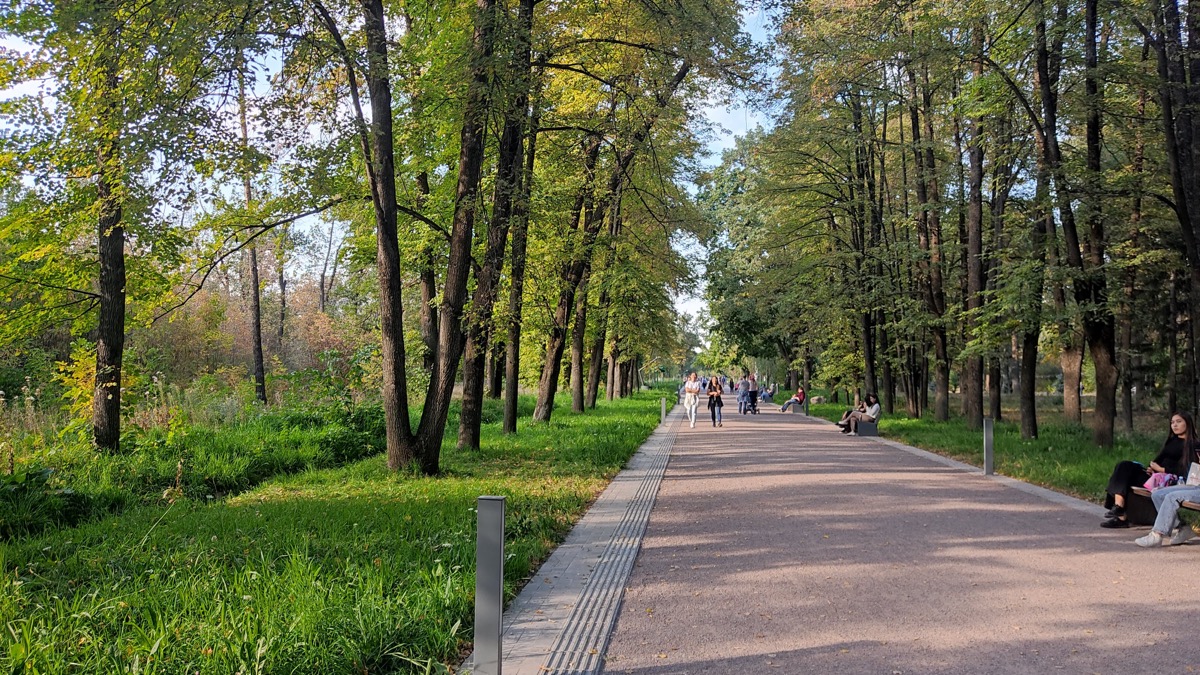
This is perhaps the only place in the city where a one-hour walk takes you through several different landscapes: a coniferous forest, a Japanese garden with a pond and bridge, a greenhouse with tropical plants. It remains peaceful even on weekends — perfect if you want to escape the city noise without leaving town. The garden is open daily from 9:00 to 20:00, except for the first Monday of the month, which is a maintenance day. It's most convenient to enter through the northern entrance on Timiryazev Street — easy to reach by public transport. The southern entrance, facing Al-Farabi Avenue, is better suited for those arriving by car.
The garden was established in 1932 on 108 hectares at once. Botanist scientists initiated the project: after the capital's relocation to Almaty, the city needed a research center for studying local flora and acclimatizing plants from other regions. In 1933, work began on dividing the plots and constructing the first greenhouses, and by 1939, the first dendrological collections were formed — the foundation of today's garden's richness. In its early years, the territory served only scientific purposes: researchers conducted studies, established collections of rare plants, and created experimental plots. Only later did the garden open to the public for leisurely strolls. Today, the garden's dendrological collection comprises 1,240 taxa — 807 species, forms, and varieties of plants from around the world. Its status remains the same as it was decades ago: it is the country's main botanical garden and a research institute of the Academy of Sciences, which includes several specialized laboratories, including a dendrology laboratory. Today, the garden also has the status of a specially protected natural area — meaning it's not just a city park, but an object under separate legislative protection.
The Japanese garden is the most photogenic part of the territory: cascades of small waterfalls, ponds with islets, pavilions in traditional style, and a thirteen-tiered pagoda among stone lanterns. Around 70 plant species grow here, some of them from Japan's Hokkaido Island, including cherry blossoms, Japanese rhododendron, and Japanese maple. Cherry blossoms are best seen in late April to early May. In other parts of the garden, bamboo stands next to lilac, and palms beside oak groves. In the alpine garden, you can see 13 of the rarest species of wild tulips: Kazakhstan is considered the official birthplace of the tulip, from where the flower spread throughout the world. There is also a rose garden and entire sections with peonies and asters. You can walk for hours: at different times of year, the garden looks completely different — the same spot in spring and autumn appears to be two entirely different gardens.