 Mountains & WalksMountains & Walks
Photo: Жасминовый Дракон, CC BY-SA 4.0 · source
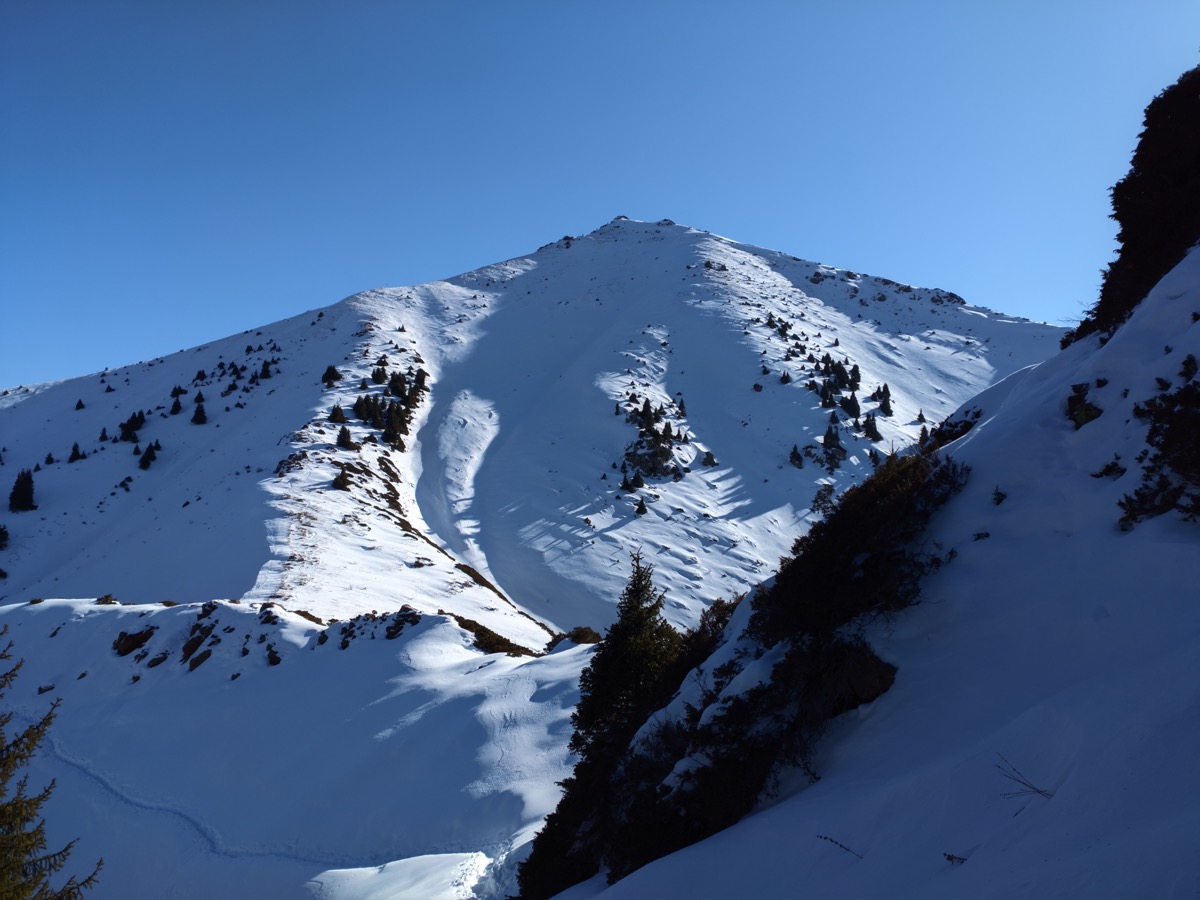
Bukreev Peak can be reached by two routes. The classic path through Butakovskoe Gorge takes 9–11 hours and covers approximately 24 km round trip, making it a full-day hike. A shorter option starting from Medeu takes 4–5 hours one way. The ascent is considered easy to moderate: no special equipment is needed, and the route is often recommended to beginners and families with older children as their first proper mountain summit rather than just a walk in the mountains.
Until 2007, this mountain was called Pionerskaya. The name was changed in the year marking the tenth anniversary of the death of Anatoly Bukreev, a Kazakhstani alpinist whom his colleagues considered one of the strongest high-altitude climbers of the twentieth century. The climbing community installed a tripod with a bell at the summit and two cast-iron memorial plaques—one with his name, the second with a prayer. Bukreev moved to Alma-Ata in 1979 after graduating from a teacher training institute. He served in the army there and remained: he worked as a ski training instructor and mountain training instructor at TsSKA, and lived on a state farm outside the city. Twice a week he climbed above 4,000 meters in the Zailiysky Alatau—training in the very mountains where a peak now bears his name.
During his career, Bukreev summited 11 of the planet's 14 eight-thousanders—18 ascents in total. In 1985, he earned the title "Snow Leopard" for conquering all Soviet peaks above 7,000 meters, and in 1989 he became the first in history to traverse all four summits of Kanchenjunga above 8,000 meters. He also climbed remarkably fast: Lhotse in 21 hours, Dhaulagiri in 17. Legendary Italian climber Reinhold Messner considered Bukreev the strongest high-altitude alpinist of the twentieth century.
True, though controversial, fame came to him through a tragedy on Mount Everest in May 1996. Bukreev worked as a mountain guide on a commercial expedition and that day reached the summit first, around half past one. That night a sudden storm broke out on the slope. Several people became lost in the darkness. Bukreev made several emergency sorties from camp alone and led out Americans Charlotte Fox and Sandy Pittman and Norwegian Tim Madsen. Journalist Jon Krakauer later criticized him in the bestseller "Into Thin Air" for descending from the summit early without a radio. This sparked disputes within the climbing community for years. Krakauer later acknowledged: "I fully value his courage in rescuing Sandy Pittman and Charlotte Fox." Bukreev himself wrote a response book, "The Climb," in 1997, and the American Alpine Club awarded him the David Souls Medal precisely for his rescue of people in the mountains.
Bukreev died on December 25, 1997: an avalanche swept him away during a winter ascent of Annapurna. Kazakhstani cameraman Dmitry Sobolev died with him. They were accompanying Italian alpinist Simone Moro, who survived this ascent. Posthumously, Bukreev was awarded the Kazakhstani medal "Erligi Ushin" ("For Valor") and included in the list of Kazakhstan's best athletes of the twentieth century. From the summit of the mountain named in his honor, one can see Almaty and the Left Talgar Gorge—the very mountains where he trained almost every week. Today people climb here not only for the panorama. Ringing the bell at the summit is a local ritual, a way to honor the memory of one of the few Almaty natives whom the entire climbing world recognized as truly great.