 With Family & FriendsWith Family & Friends
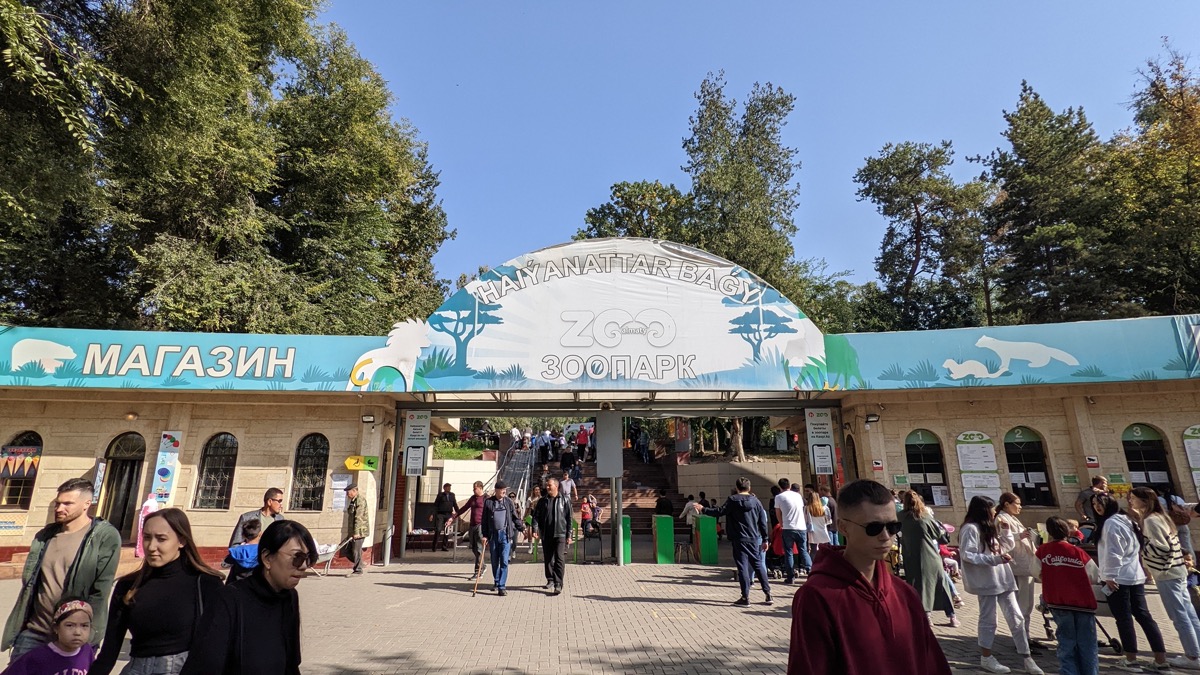
Photo: Vano111ru, CC BY-SA 4.0 · source
The zoo occupies 21 hectares on Yesenberlin Street within the city limits — you can easily reach it by public transport without needing a car. Home to over 380 animal species, it offers a classic half-day route from lions to penguins, with stops at each enclosure. In summer, it's best to visit early in the morning or towards evening when animals are more active and the heat subsides. For children, it remains the top destination in the city to see a lion, elephant, or tiger just meters away — not through a screen, but in person.
The decision to build a zoo in Alma-Ata was made in January 1935. The location on the right bank of the Kazachka River was chosen by hunter Murzakhan Tolebayev. On February 19, the city council allocated 46 hectares for the zoo. Tolebayev himself caught saigas, mountain goats, and jerboas across the Kazakh steppes. He then secured funding to purchase animals from the zoos of Moscow and Leningrad. The grand opening took place on November 7, 1937, with 70 species in the collection. From Moscow came emus and bison, from Ashkhabad — hyenas and caracals, from Leningrad — a polar bear and reindeer, and from the Askania-Nova nature reserve — African antelopes. Tolebayev's own fate proved tragic. Less than a month after the opening, on December 5, 1937, he was arrested by NKVD officers. A year later, he was executed on false charges. The man who created the zoo never lived to see its success. The hardest times came during 1941–1945. Some staff members went to the front, and food supplies became scarce. Workers bought donkeys from local residents to feed the carnivores, but some animals still died from hunger. The zoo survived the war and continued to grow: by 2005, the territory had expanded to 54 hectares, and today it occupies the more compact 21 hectares.
The most famous resident in the zoo's history was the elephant Batyr. He was born here to elephants named Palma and Dubas. In the winter of 1977, staff noticed that the elephant mimicked sounds around him: human speech, dog barking. He could produce something resembling a request for water. From 1979, his abilities were studied seriously. Several articles about this unusual phenomenon appeared in the Soviet press, and Batyr became the subject of genuine linguistic research — a rare case of a zoo animal attracting scientific attention, not just children at the enclosure. Scientists eventually concluded it was more sound imitation than actual speech in the full sense — but this didn't diminish the elephant's fame. There's a story that when local television crews came to film a documentary about him, Batyr deliberately stayed silent. But then he did produce something very articulate in their direction — clearly not meant for broadcast. Batyr died in 1993, but the legend of the talking elephant lives on in Almaty to this day.
Today, the zoo is home to around 4,000 animals, birds, and reptiles — nearly 385 species. 76 of them are on the international list of rare species, and 24 are in the Red Book of Kazakhstan. 2025 became a record year: the zoo received about 1.2 million visitors, 87 babies of 31 species were born, and the institution was accepted into the European Association of Zoos and Aquariums. Recent arrivals include a pair of tamanduas, South American anteaters specializing in termites and ants, named Theo and Lara, as well as a bison, civet, genet, and agama. A major reconstruction is planned for 2026, though it depends on funding. Old enclosures will be rebuilt into more spacious ones. First in line is the 'Arctic' zone with polar bears, Arctic foxes, and snowy owls, followed by the 'African Savanna' with hippopotamuses and giraffes. After the renovation, the zoo expects to welcome up to 2 million visitors annually — almost double the current number.