 With Family & FriendsWith Family & Friends
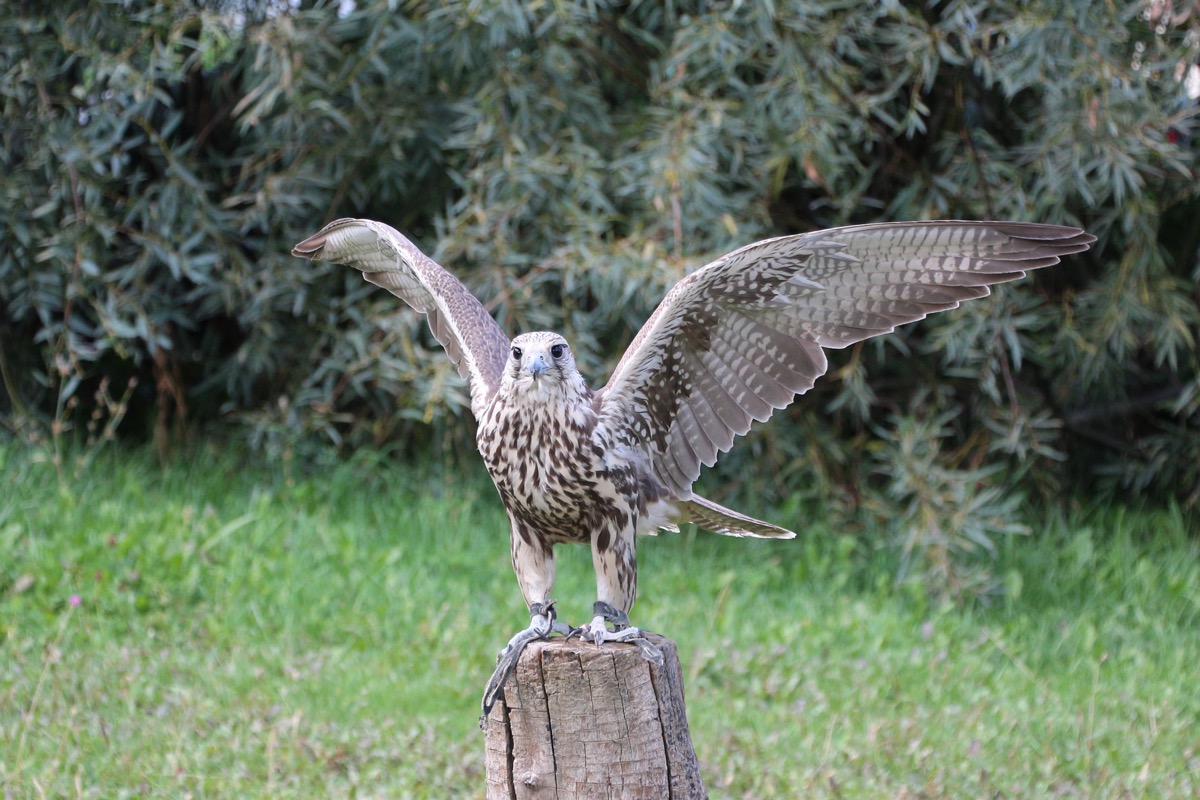
Photo: Bernard Gagnon, CC0 (общественное достояние) · source
Sunkkar is situated in the foothills at the entrance to Bolshoe Almatinskoe Gorge. This territory belongs to the Ile-Alatau National Park, 7–8 km from the city—approximately twenty minutes by car from Almaty. The grounds with aviaries and pond are open daily year-round. From March to November, except Mondays and Tuesdays, at 17:00 a falconry show takes place here: a golden eagle "hunts" a wolf decoy, while a saker falcon dives at tremendous speed after prey directly over the heads of spectators. The birds at the show are handled by falconer Pavel Pfander—typically up to a dozen different species of raptors participate in the program. Even without the show, a walk along the aviaries with eagles, falcons, and owls is worthwhile: you won't see such raptors up close in the city.
The breeding center was founded in 1989 to save the saker falcon, a species listed in the Red Book of Kazakhstan. During the 1980s and 1990s, it was massively exported to Persian Gulf countries. Demand for falconry drove prices to astronomical levels, and the saker falcon population in Kazakhstan's steppes began to plummet rapidly. The center's founder, Viktor Ertasovich Bulekbaev, began with 13 saker falcons. His idea differed from what had been done before: rather than simply showing raptors to the public, he bred them in captivity and released them back into the wild. By the center's 25th anniversary in 2014, 632 birds had been successfully released into the wild. Since then, that number has grown to approximately 870, with about 700 being saker falcons. Thus Sunkkar gradually grew into one of the world's largest raptor breeding facilities.
Today, the center breeds more than just saker falcons. Eagles, golden eagles, peregrines, gyrfalcons, owls, black vultures, and buzzards live and breed in the aviaries—some of them are also listed in the Red Book. The fate of each chick is planned years in advance: roughly a third remains at the center for further breeding, a third is sold legally as an alternative to the black market, and another third is released into the wild. Some birds still die at a young age despite proper care. To track released birds, satellite chips are installed on them—each costs more than 3,000 dollars, and this is only part of the center's expenses. The government does not finance Sunkkar; everything is maintained through private funds. Today the center is run by Galina Afanasyevna Osipova. The work begun by Bulekbaev in 1989 has not been abandoned over the decades but has instead expanded.
Sunkkar also has a lesser-known project—the Kazakh sighthound tazy. This hunting breed, which worked alongside raptors for centuries, was nearly lost in the twentieth century. The center spent 25 years on selective breeding work and revived the breed anew. The result was not simply saving one falcon species but returning to the city a piece of steppe hunting tradition in its entirety—bird and dog together, as people hunted for centuries in the Kazakh steppes.