 MuseumsMuseums
Photo: Togzhan Ibrayeva (Tokatosha), CC BY-SA 4.0 · source
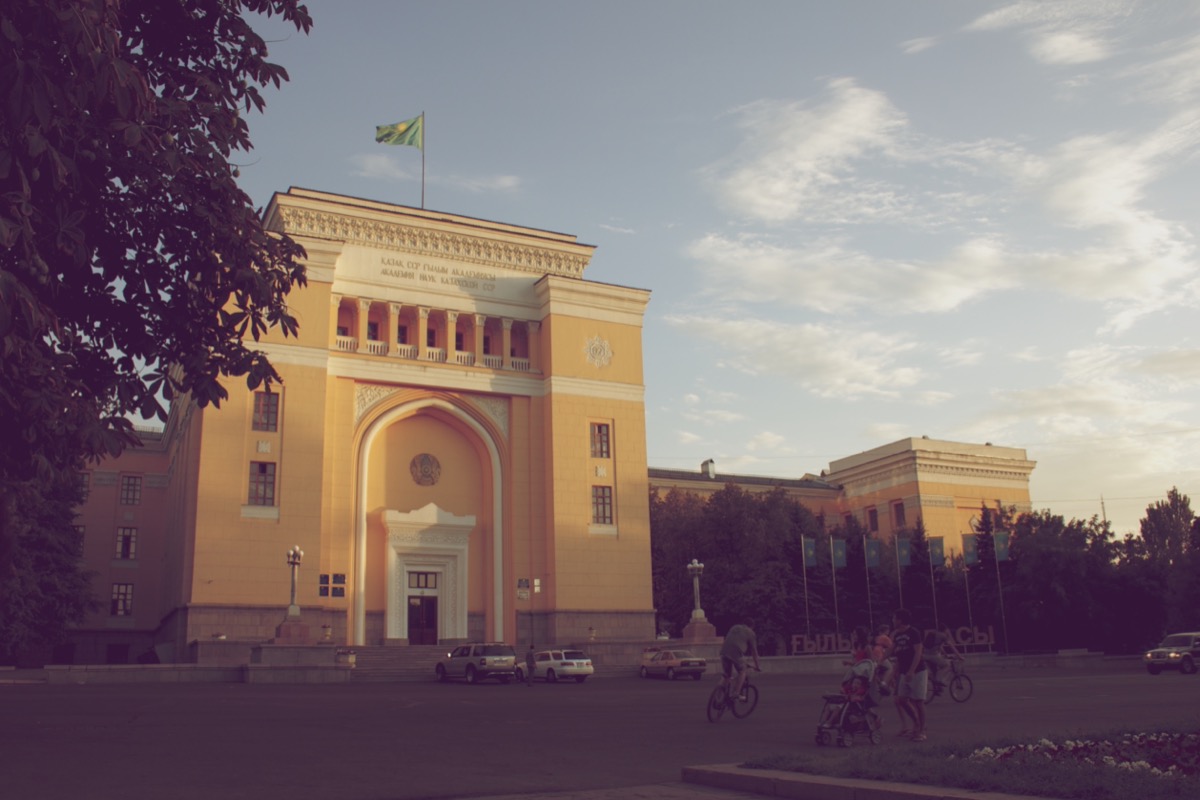
The Museum of Archaeology of Kazakhstan is located at 28 Shevchenko Street, in the Gylym Ordasy complex — the building of the Academy of Sciences. Several smaller departmental museums operate under the same roof, but the archaeological museum has the most prominent history. It was here in 1969 that they began studying the discovery from the Issyk kurgan: a Saka warrior in golden armor, which became one of Kazakhstan's main symbols. The golden costume itself is now mostly stored and displayed in Astana. But this is where the story began, and here lies vast archaeology spanning from the Bronze Age to the Medieval period. The museum is open Monday through Friday from 9:00 to 18:00 and Saturdays from 10:00 to 17:00, with a lunch break; closed on Sundays. A single ticket grants access to all four museums of the complex, including the Museum of Nature and the Museum of Rare Books, so plan for a longer visit.
The museum was founded in 1973 on the initiative of Dinmukhamed Kunayev, First Secretary of the Communist Party Central Committee of Kazakhstan. It was created by the country's leading scientists: archaeologist Alkei Margulan, Akay Nusupbekov, Kemal Akishev, Hasen Alpysbaev, Mir Kadyrbaev, and Alla Maksimova. The first exhibition was housed in a different building on Lenin Prospekt — now Dostyk Prospekt. During 1969–1970, an expedition led by Kemal Akishev excavated the Issyk kurgan, located 53.5 kilometers from Almaty, standing 6 meters high with a diameter of 60 meters. In the burial chamber, they discovered the remains of a Saka warrior in golden clothing, more than 4,000 gold objects, an iron sword and dagger, a bronze mirror, and clay and wooden vessels. The burial was dated to the 5th–4th centuries BCE. In 2010, the museum was transferred to the authority of the Gylym Ordasy cultural and educational center, and after major restoration, it reopened at its current location in 2012.
Besides the gold of Issyk, the museum contains a reconstruction of the burial chamber of kurgan No. 11 from the Berel burial ground at the foot of the Altai: bones of horses and saddles of Saka warriors from the 4th–3rd centuries BCE, discovered by archaeologist Zeinolla Samashev. A complete reconstruction of the horse trappings was performed by restorer Krym Altynbekov. Berel only gained wide recognition in 1998 following this discovery. The museum also houses Bronze Age materials — burial grounds of the Begazy-Dandybai culture, discovered in 1946 — and medieval finds: ceramics, glass, and coins from Otrar, Taraz, Turkestan, and Talgar, cities along the Great Silk Road. For those wanting to understand the archaeology of Kazakhstan in its full depth and not just through one golden costume, this is the best starting point in the city.