 MuseumsMuseums
Photo: Togzhan Ibrayeva (Tokatosha), CC BY-SA 4.0 · source
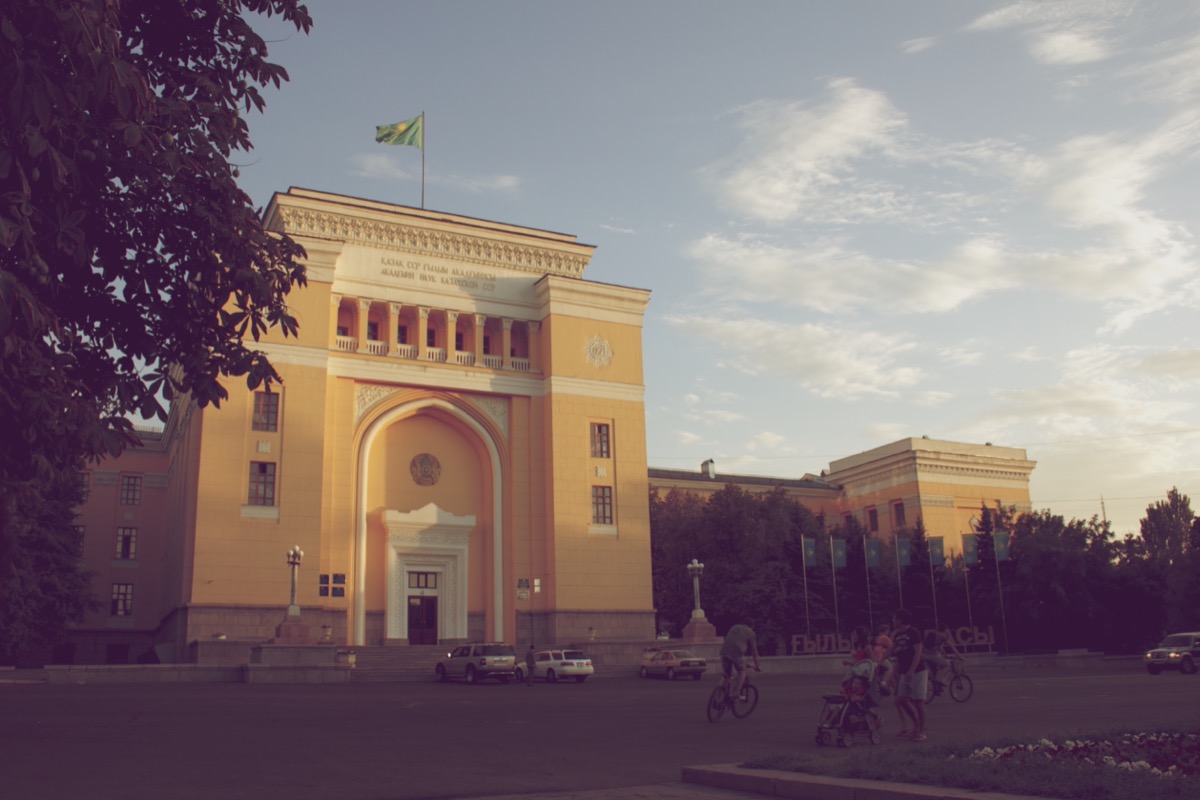
The Museum of Nature is housed in the Gylym Ordasy complex on Shevchenko Street — just a stone's throw from the Archaeology Museum, though it is a separate institution with its own entrance and ticket. With just two halls, the Paleontological and Zoological sections, you can tour the museum in about an hour, though it's worth allowing a bit more time. The museum operates on weekdays from 09:00 to 18:00, with a lunch break from 13:00 to 14:00; it is closed on Saturdays and Sundays — a rare case of an Almaty museum that doesn't operate on weekends, so plan your visit for a weekday. Admission is quite affordable: 150 tenge for adults, 100 tenge for students and pensioners, and free entry for preschool children and war veterans.
The first paleontological discovery in Kazakhstan's history was made in 1912 by mining engineer P. Matveev — on the Kara-Turgay River in Central Kazakhstan. The bones were initially mistaken for mammoth remains. Their true nature was later identified by academician Alexei Borysyak: in 1916, after studying a similar skeleton found near the Aral Sea, he classified the discovery as a separate genus — Indricotherium, the largest land mammal in Earth's entire history. Almost simultaneously, American paleontologists uncovered similar bones in Baluchistan and Mongolia and named the creature "Baluchiterium." However, Russian scientists proved slightly faster and succeeded in establishing their name first. The baton was then passed to Soviet zoologists. In March 1932, the Kazakhstan branch of the USSR Academy of Sciences opened in Alma-Ata, with the first scientific staff relocating from Leningrad, and the zoological department became one of the two initial research directions. In 1943, the department was reorganized as an independent institute, and from 1946, following the establishment of the Academy of Sciences of the Kazakh SSR, it became part of its structure. These scientists collected materials from across Kazakhstan between 1932 and 1957, on the basis of which the museum was officially opened by decree on April 29, 1961. After restoration, the museum reopened in 2012 — now in the Gylym Ordasy complex, in the eastern wing of the Academy of Sciences building.
The scale of Indricotherium is difficult to comprehend visually until you stand beside it: the creature reached 9.2 meters in length, 5.4 meters in height, and weighed 20–30 tons — four to six times heavier than a modern elephant. Only the giraffe surpassed Indricotherium in height among land mammals. Nearby in the hall are equally impressive neighbors: a six-meter skeleton of a Tarbosaurus, a carnivorous dinosaur from the tyrannosaurid family and a close relative of the Tyrannosaurus rex, and a mammoth skeleton. All the paleontological hall's exhibits share one condition: the discovery must originate from Kazakhstan's territory. For a natural history museum, this is a rare and principled position — most similar collections gather finds from around the world, but here they display only what was found in the native mountains, steppes, and deserts.
The zoological hall is organized differently — not fossils, but modern nature of Kazakhstan: taxidermy, herbarium specimens, photographs, and models. The exhibition is divided by natural zones — mountain and desert landscapes — and you can encounter mounted specimens of argali sheep, wolves, bears, lynxes, and numerous birds. A separate diorama is dedicated to the wild fruit forests of the Almaty Nature Reserve, while the walls feature displays on "Birds of Our Region" and "Plant Life." For a museum with such a limited number of halls, the density of exhibits is remarkably high: there is genuinely time to examine each display case rather than rushing through to the dinosaurs.
The museum is particularly well-suited for visits with children: there are no lengthy wall texts or academic dryness, but rather a skeleton the size of a bus and mounted animals within arm's reach. In the same Gylym Ordasy complex on Shevchenko Street, several other museums operate — archaeology, history of Kazakhstan, rare books — so if desired, a visit can be extended to half a day and multiple exhibitions can be toured in succession without traveling across the city. And since the Museum of Nature is closed on weekends, the best option is to stop by on a weekday, on the way to the city center.