 MuseumsMuseums
Photo: МаратД (MaratD), CC BY-SA 3.0 · source
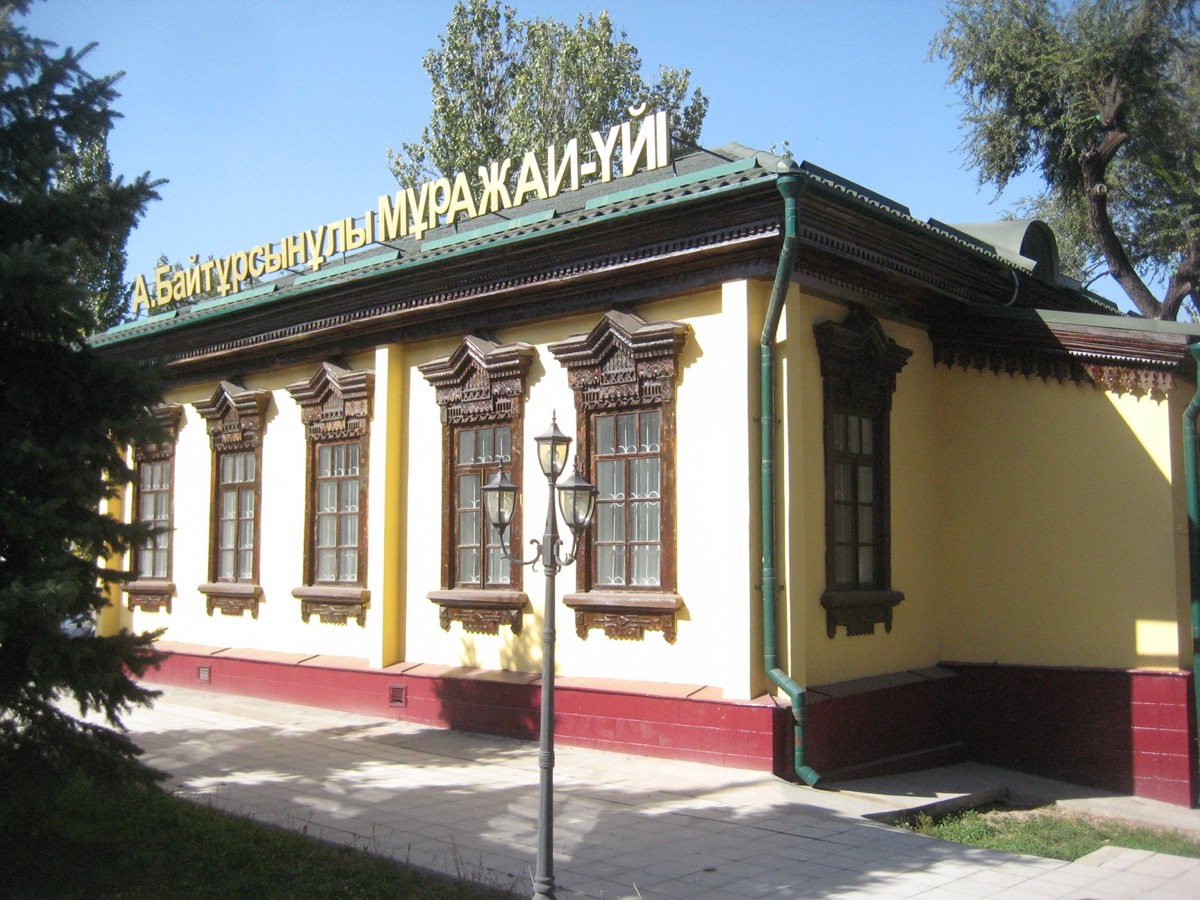
The Akhmet Baitursynov House Museum stands at Baitursynov Street, 60—the very place where the Kazakh linguist and thinker actually lived. In Kazakhstan, he is called the Teacher of the Nation, "Ult ustazy." The exhibition occupies three rooms: a former dining room, a children's room, and the owner's study. The first two halls are bright and warmly domestic. They contain original documents, photographs, and personal belongings, as well as copies of these items. The third hall is deliberately dark: it is dedicated to Baitursynov's arrest in 1929 and his execution in 1937. This contrast, from a warm family setting to a grim conclusion, holds attention more powerfully than any museum label. The museum is small and will not take much time to visit. However, before your visit, it is worth at least briefly learning about Baitursynov's biography and the history of the Alash movement: then the exhibits take on an entirely different meaning.
The house itself is a single-story wooden structure made of logs from Tian-Shan spruce, built on a stone foundation with whitewashed walls. It represents typical early 20th-century merchant architecture in old Verny. At that time it stood on Taranchina Street. Baitursynov lived here with his family from 1934 to 1937. By then, he was already known as the creator of the Kazakh alphabet: in 1912, he removed superfluous letters from Arabic script and added missing signs needed for the Kazakh language. The reform was called "Zhana emle"—"new orthography." It is still used today by Kazakhs in China, Afghanistan, and Iran. In December 1917, at the Second All-Kazakh Congress in Orenburg, the autonomy of Alash-Orda was proclaimed, and Baitursynov entered its government as one of the leaders of the "Alash" party. The party demanded autonomy for Kazakhstan, universal suffrage, freedom of speech and press, and fair land policy. The government of the autonomy was headed by Alikhan Bukeykhanov. The Bolsheviks liquidated the autonomy in March 1920. After an amnesty, Baitursynov sided with Soviet power and even joined the Bolshevik party—this did not save him. In 1929, he was arrested and sent first to prison in Kyzylorda, then into exile in the Arkhangelsk region. In October 1937, he was arrested again, and on December 8, he was executed as an "enemy of the people." Baitursynov was only rehabilitated in 1988, half a century after his first arrest.
The house received the status of a historical monument immediately after rehabilitation, in 1988. At that time, Baitursynov's children and grandchildren decided to open a museum there. It proved to be difficult: by then another family was living in the house, and most of the enlightener's personal belongings had been destroyed during the arrest. The exhibits had to be gathered anew, piece by piece. The museum opened in 1993, and after restoration, officially reopened on September 12, 1998. Today its collection contains around 500 materials about Baitursynov's life and scientific activities: manuscripts, textbooks he compiled, and archival photographs of himself and his comrades from Alash-Orda. It is here, in these three modest rooms, that one can most easily understand the price paid in 20th-century Kazakhstan for the right to write and speak in one's native language.