 Mountains & WalksMountains & Walks
Photo: YermuratD, CC BY-SA 4.0 · source
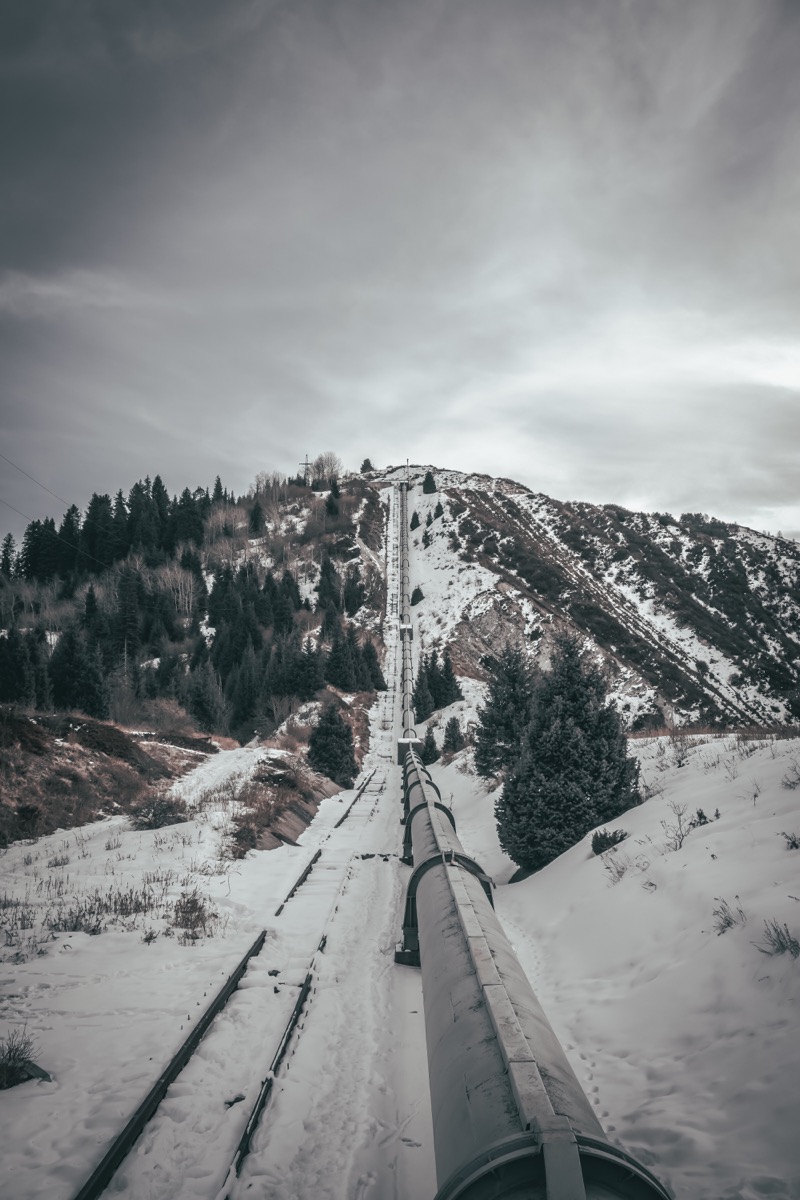
The road winds through a steep right slope of Big Almaty Gorge at an elevation of 1,900 to 2,000 meters within the Ile-Alatau National Park. You can start the hike from three different points—for example, from the ecopost on Dulati Street. However, all route options converge at the Ayusay visitor center, which is also a logical endpoint for the day: there are maps, equipment rental, and safety briefing available. The full loop is approximately 18 km and takes 5–8 hours of walking. There are also shortened options for those who don't have a full day in the mountains. Only one section is technically challenging—a steep 1.2 km stretch with a metal staircase. The rest of the trail is well-maintained and requires no special equipment: regular trekking shoes are sufficient. Along the way, you can see neighboring peaks of BAP, Molodyozhniy, and Sovetov. The road runs almost entirely along an open slope without dense forest, so the panorama is not obscured by trees.
The road was not built for tourists, but for construction—it served the development of a cascade of hydroelectric power stations on the Big Almaty River. The decision about the cascade was made by the USSR State Defense Committee at the beginning of the Great Patriotic War. The Leningrad institute Gidroproject began design work in 1942, and construction started in April 1943. In August 1945, Soviet forces defeated the Kwantung Army in Manchuria. Over half a million Japanese soldiers were taken prisoner. The Communist Party of Kazakhstan distributed approximately 50,000 prisoners across cities in the republic, and some of them built this road and worked on the gorge slope. In Alma-Ata, prisoners were held in camp No. 40 and its branches—behind barbed wire, under guard, in harsh conditions. The camp existed until July 15, 1948, and the last prisoners were repatriated by 1949. August 9, 1948 is considered the official founding date of the cascade as a unified enterprise. With the commissioning of Hydroelectric Power Station No. 2 in July 1959, construction on the Big Almaty River was completed, and Hydroelectric Power Station No. 1 became the highest-pressure hydroelectric power station in the entire USSR. In the 1950s, the cascade provided up to half of all electricity for Almaty.
Along the trail, remains of stone structures are still visible—prisoners lived in them during construction. Old mine shafts, partially filled with water, can also be found. In the thickets along the road grows Siversia apple—a wild species that geneticists consider the ancestor of all cultivated apples. In the Almaty mountains, it is abundant, and an entire apple orchard for it has been planted at the visitor center. It is precisely this combination of history and nature that makes the route special: a mountain walk rarely turns out to be a walk through the military history of the region at the same time. The route is passable year-round. In spring and autumn, it is advisable to check the condition of the approaches to the starting points: the trail itself is well-maintained, but gravel roads to it can become muddy after rain or snow melt. The park itself, where the route is laid, is one of the oldest in the country. It grew from the Almaty Nature Reserve, founded in 1931, and received national park status in 1996. Further up the same Big Almaty Gorge is Big Almaty Lake—you can drive there separately. Nearby is a high-altitude space station where cosmic rays have been studied since 1957. With an extra day available, the route can easily be extended in that direction.